


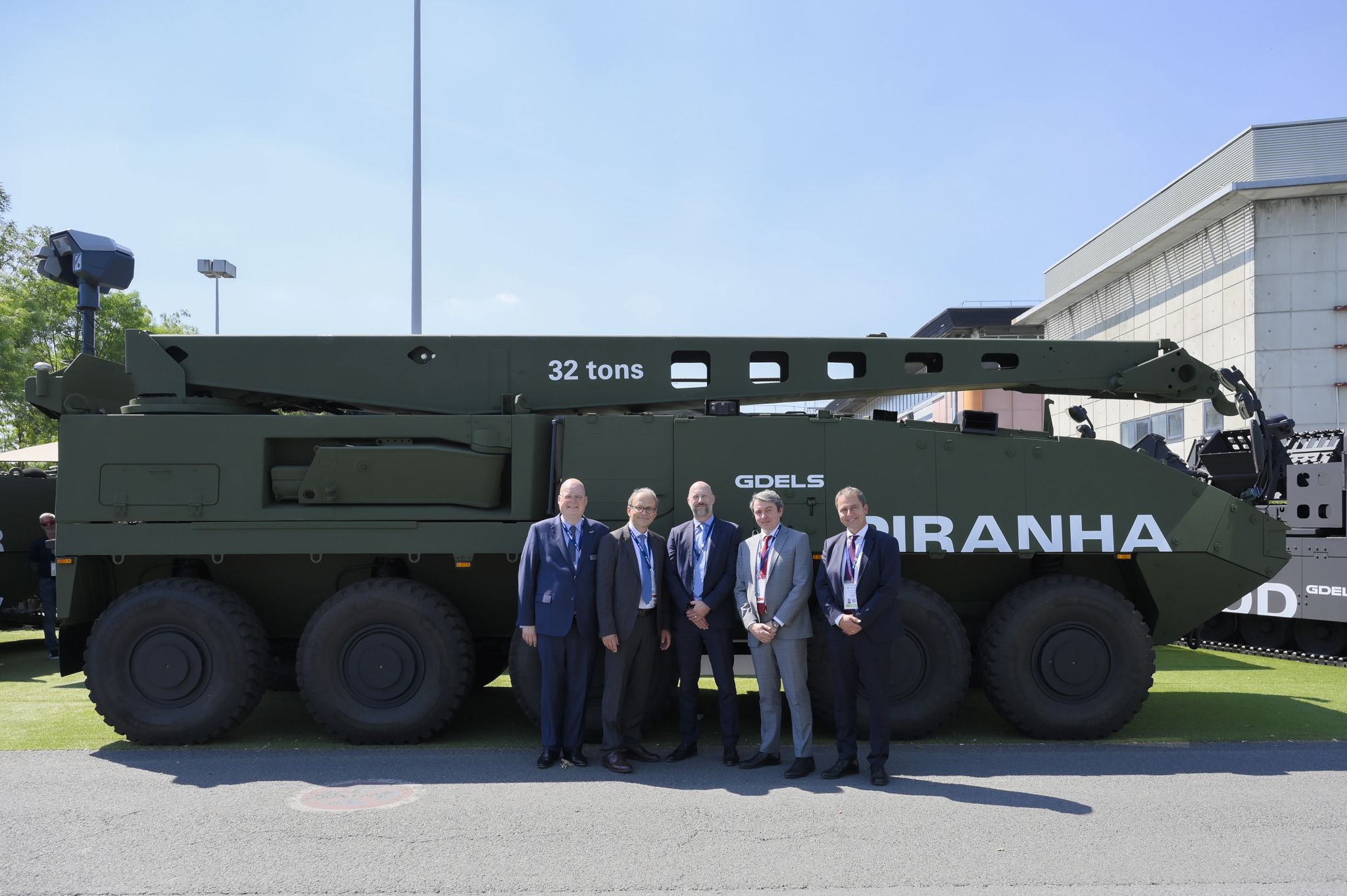
General Dynamics European Land Systems (GDELS) has expanded its wheeled armored vehicle portfolio with the public debut of its PIRANHA Heavy Mission Carrier (HMC) Advanced Recovery Vehicle (ARV) at the Eurosatory 2026 defense exposition. The platform represents the latest evolution of the 10×10 PIRANHA HMC architecture, which GDELS first introduced in 2024 to accommodate increasingly heavy mission payloads and complex subsystems. By integrating a specialized recovery mission module developed by Germany’s Flensburger Fahrzeugbau Gesellschaft (FFG), GDELS aims to capture a growing market requirement for heavy, highly mobile combat support vehicles capable of keeping pace with modern mechanized formations.
“This solution is not an isolated platform, but serves as capability enabler, designed to operate under pressure, adapt to changing requirements and support increasingly integrated operational concepts” said Alejandro Page, GDELS Vice President & Managing Director of GDELS Santa Bárbara Sistemas.
The PIRANHA HMC ARV utilizes a 10×10 drivetrain configuration to distribute the significant structural loads imposed by the heavy recovery apparatus while maintaining off-road mobility. The vehicle is equipped with a high-performance mission module from FFG, featuring a 32-metric-ton crane alongside dual recovery winches. According to GDELS, this configuration makes the PIRANHA ARV the most powerful wheeled military recovery vehicle currently available on the commercial market. The platform is optimized for the rapid recovery, towing, and field repair of damaged or immobilized combat vehicles under full armor protection. The introduction of the ARV variant underscores the maturity of the GDELS vehicle platform strategy. By utilizing a common 10×10 chassis across multiple heavy configurations—including previously announced options for tactical bridging, protected troop transport, and heavy artillery (howitzer) systems—the manufacturer is positioning the PIRANHA HMC line as a comprehensive, single-platform solution for medium and heavy brigade combat teams.

To operate safely within the forward edge of the battle area (FEBA), the PIRANHA HMC ARV retains the core survivability features of the broader Mowag PIRANHA family. The vehicle’s protective suite is built around a high-hardness armored steel hull incorporating integrated, comprehensive mine-blast protection. The platform utilizes a scalable, modular add-on armor system certified under STANAG 4569 protocols. This allows operators to tailor the vehicle’s ballistic and blast protection levels based on specific theater threat profiles. Furthermore, the architecture is designed to accept optional defensive upgrades, including: Rocket-Propelled Grenade (RPG) defeat kits, Anti-bomblet/top-attack protection modules and Active Protection Systems (APS).
Originally designed by Switzerland’s Mowag (rebranded as GDELS-Mowag GmbH in 2010), the PIRANHA lineage spans five generations and remains the most commercially successful Western wheeled armored vehicle family, with over 12,000 units in service globally. This includes extensive derivative lineages such as the US Army’s Stryker and the international Light Armored Vehicle (LAV) series. The transition toward 10×10 variants reflects a broader industry trend where increasing vehicle weights—driven by heightened protection demands and the integration of complex electronic architectures—have pushed traditional 8×8 platforms to their payload limits. By offering the ARV variant on a 10×10 wheeled chassis, GDELS provides logisticians with a high-mobility asset that avoids the transport and maintenance overhead associated with traditional tracked recovery vehicles, while preserving the capability to support modern, heavily armored wheeled fleets.


