


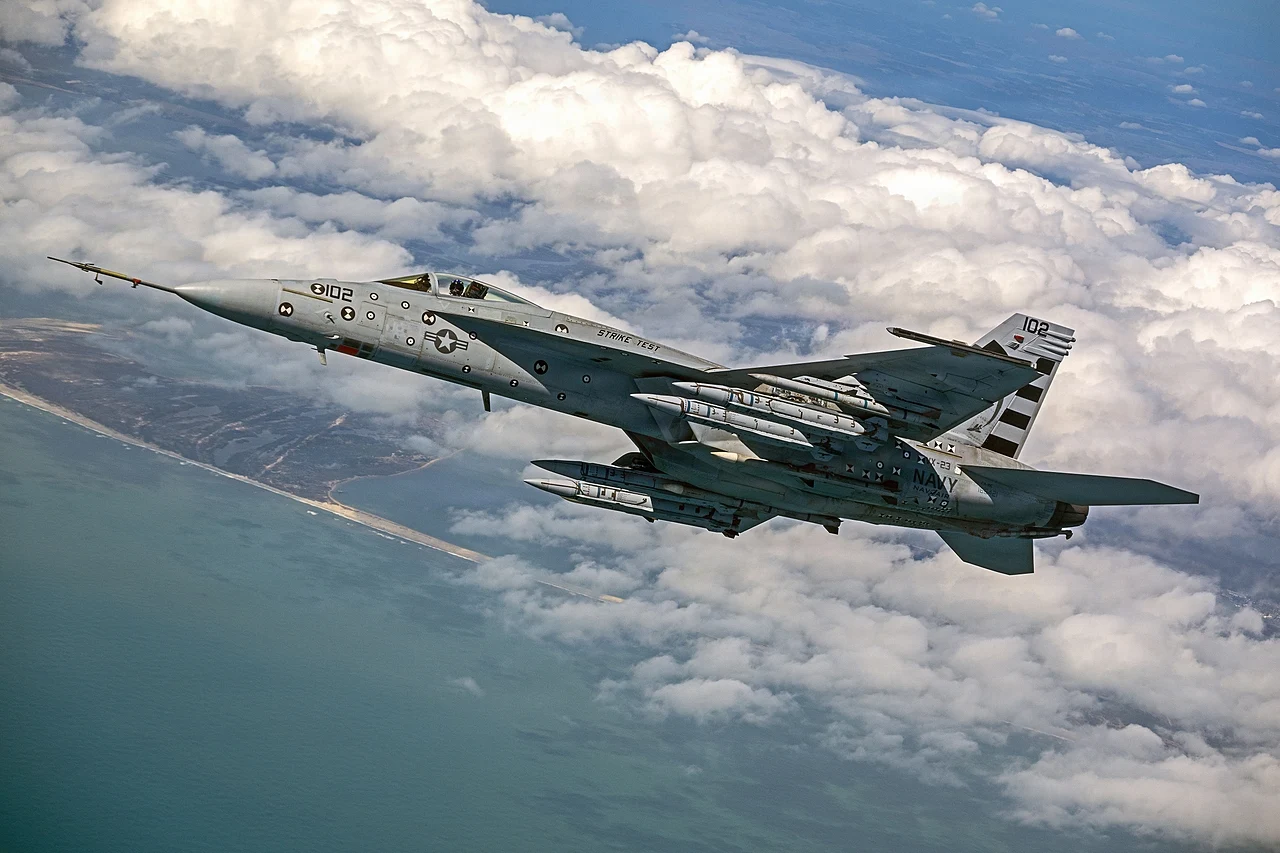
The US Navy has revealed the existence of its new AIM-424 ‘Malice’ Long-Range Air-to-Air Missile (LRAAM) during the annual Tailhook Symposium on 22 August 2026, confirming that the advanced effector is currently undergoing active flight testing. Developed by Raytheon to significantly bolster fleet air defense and maintain decisive air dominance against high-tier threats, the AIM-424 represents a two-stage weapon system broadly comparable in size to the recently disclosed AIM-174B Gunslinger, albeit designed slightly shorter and lighter. Imagery released via the Defense Visual Information Distribution Service (DVIDS) depicts an F/A-18E Super Hornet assigned to Air Test and Evaluation Squadron 23 (VX-23) carrying four AIM-424 test rounds. Weighing approximately 1,500 lb (680.4 kg) with a length of 13.5 ft (4.11 m) and a body diameter of 13.5 in (0.34 m), the solid-propellant missile delivers an engagement reach in excess of 250 n mile (463 km). Intended for integration onto the Boeing F/A-18E/F Super Hornet, Lockheed Martin F-35C Lightning II, and the future Next-Generation Air Dominance F/A-XX platform, the weapon system yields a generational leap in air combat capabilities well beyond the current Raytheon AIM-120 AMRAAM inventory.
Strategic imperative driven by emerging anti-access/area-denial (A2/AD) capabilities in the Indo-Pacific region has significantly accelerated the development timeline for the AIM-424 program. The US Navy faces escalating pressure to extend the defensive perimeter and striking reach of its carrier strike groups in response to long-range threat platforms fielded by the People’s Liberation Army Air Force and Navy. With China deploying air-launched anti-ship ballistic missiles and standoff cruise missiles with ranges exceeding 1,000 n mile, Western defense planners require an organic air-to-air weapon capable of intercepting threat launch platforms before they can release their anti-ship ordnance. By directly integrating into the Department of Defense’s broader integrated deterrence concept, the AIM-424 provides naval and marine aviation forces with enhanced lethality, operational survivability, and the engagement range necessary to neutralize maritime-strike bomber formations and intelligence-gathering assets far outside the carrier battle group’s vulnerability zone.

Defense analysts note that the underlying concept for the AIM-424 appears to trace its origins to classified long-range missile research programs spanning nearly a decade. Industry observers highlight direct lineage to the USAF-led Long Range Engagement Weapon (LREW) special access program, which was first publicly referenced in 2017 during a defense industry presentation. The original LREW requirement envisioned a two-stage air-to-air missile capable of being stowed internally within the weapons bays of fifth-generation stealth fighters such as the F-35 and F-22 Raptor. While specific classified details regarding guidance suites, propulsion architecture, and exact operational deployment schedules remain strictly guarded for operational security, official navy statements confirm that the Advanced Technology team’s approach behind the AIM-424 provides a multi-stage configuration explicitly designed to out-range modern foreign combat aircraft and long-range air-to-air weapons.
The active flight-testing phase of the AIM-424 comes as both the US Navy and US Air Force simultaneously prepare to field the Lockheed Martin AIM-260 Joint Advanced Tactical Missile (JATM). Navy officials have clarified that the AIM-424 is a distinct, complementary program developed concurrently alongside the AIM-260 to create a tiered, deep-magazine air-dominance structure. While the AIM-260 addresses intermediate long-range air-to-air requirements, the larger two-stage AIM-424 serves as a specialized heavy interceptor focused on extreme-range defense and carrier strike group protection. Navy leadership emphasized that the introduction of the AIM-424 delivers a pivotal capability shift, ensuring that naval strike forces retain operational maneuverability and air dominance across increasingly contested, sensor-dense operational environments worldwide.


