


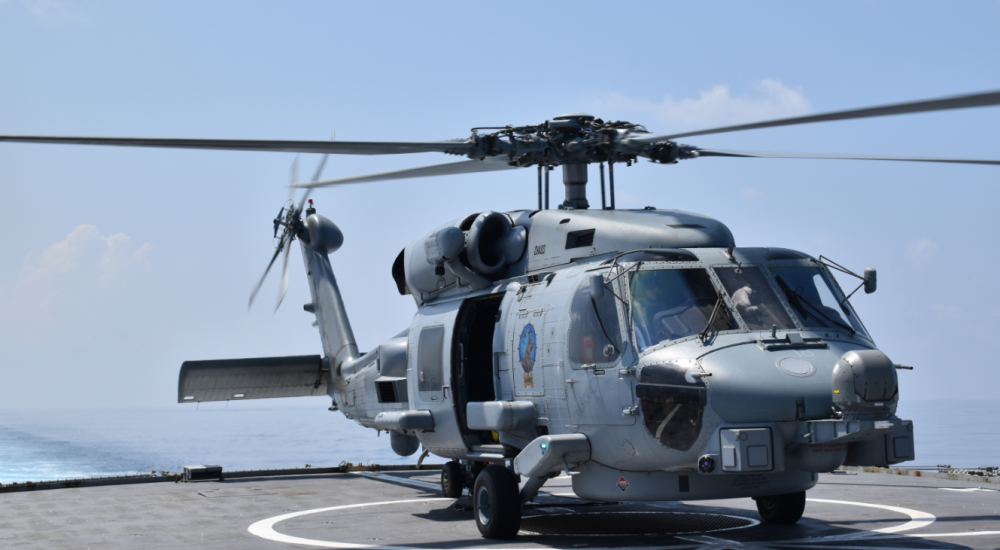
The New Zealand Government has formally concluded an agreement with the United States to acquire five Sikorsky MH-60R Seahawk maritime helicopters alongside associated weaponry and support systems in a deal valued at NZD 1.648 billion in capital expenditure, backed by NZD 110 million in average annual operating funds over the next decade. Deliveries of the multi-mission rotary-wing aircraft are scheduled to commence in 2030, with future phases of the wider procurement program expected to encompass training systems, new infrastructure at Royal New Zealand Air Force Base Auckland in Whenuapai, and complementary uncrewed aerial systems. Operable from air-capable naval vessels, the incoming platforms will be flown by Royal New Zealand Navy aircrews and maintained by Air Force personnel, providing seamless interoperability with the Australian Defence Force and allied maritime forces across the Indo-Pacific region.
The acquisition marks a major operational transition for the New Zealand Defence Force, delivering enhanced speed, payload capacity, and operating range compared to existing maritime assets, thereby significantly expanding the offensive, defensive, and surveillance envelopes of New Zealand’s frigate fleet. Driven by twin turboshaft engines and based on the United States Army’s UH-60 Black Hawk airframe, the Sikorsky S-70-family maritime derivative features folding main rotor blades and a hinged tail section designed to minimize the aircraft’s footprint within shipboard hangars. The MH-60R configuration combines multi-mission flexibility with high performance, supporting a maximum speed of 333 km/h (180 kt), a operational range of 963 km (520 nmi), and payload capacity exceeding 1,500 kg in utility transport roles.
The modern MH-60R variants represent the operational continuation of a legacy shipborne rotary-wing architecture established by the United States Navy, which historically acquired H-60 variants designated as the SH-60B, SH-60F, HH-60H, MH-60R, and MH-60S. Initially, early SH-60B variants proved too large to embark on smaller surface combatants, requiring the US Navy to operate them alongside smaller Kaman SH-2F and SH-2G Super Seasprite models until 2001. Over more than three decades of fleet employment, early-model Seahawks underwent progressive drawdown, with legacy SH-60B platforms retiring in 2015, followed by the retirement of F and H variants in 2016 to facilitate a forcewide transition to upgraded MH-60R and MH-60S fleet standards.
Equipped to execute complex mission profiles—including anti-submarine warfare (ASW), anti-surface warfare (ASUW), naval special warfare (NSW) insertion, search and rescue (SAR), combat search and rescue (CSAR), vertical replenishment (VERTREP), medical evacuation (MEDEVAC), and maritime counter-terrorism—New Zealand’s MH-60R aircraft will deploy with a standardized combat payload capability. Ordnance integration options include Mk 54 lightweight anti-submarine torpedoes, AGM-114 Hellfire air-to-surface missiles, the Advanced Precision Kill Weapon System (APKWS), and crew-served machine guns. Operated by a core crew of three, the incoming Seahawks will form the backbone of New Zealand’s naval aviation capability well into the mid-21st century.


