


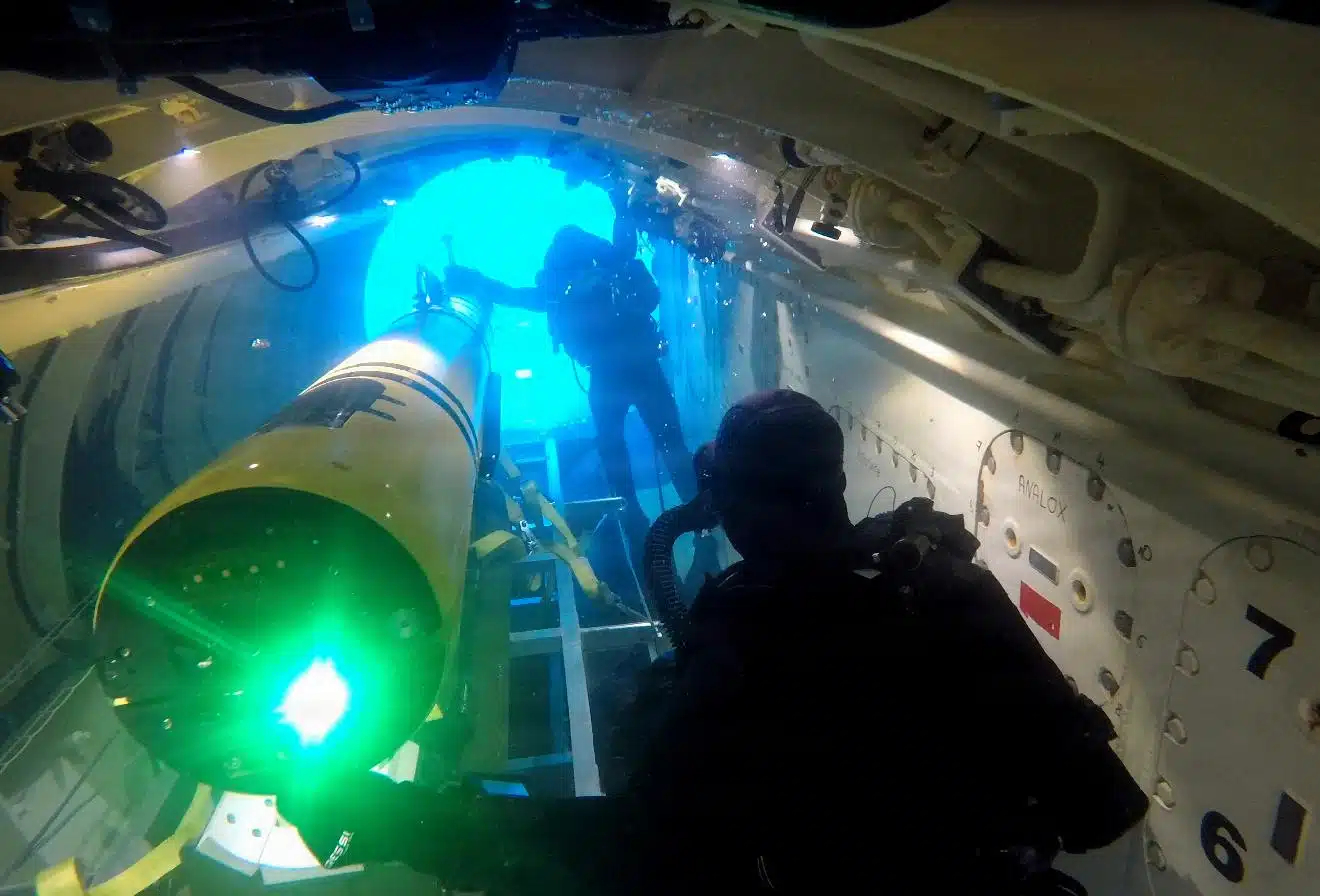
A Suffren-class nuclear-powered submarine has successfully deployed a Razorback unmanned undersea vehicle during bilateral undersea trials with the United States Navy, marking a notable advance in allied interoperability. Conducted off Toulon between 16–20 March, the activity demonstrated the ability to operate U.S. unmanned systems directly from a partner nation’s submarine—an integration milestone that underscores growing operational alignment between the two navies. According to official statements, the Razorback UUV was launched from a French attack submarine while submerged, leveraging the platform’s Dry Deck Shelter (DDS). The DDS—an externally mounted, removable module—enables deployment and recovery of unmanned systems, swimmer delivery vehicles, and special operations forces without requiring the submarine to surface. This capability provides a distinct tactical advantage, particularly in contested environments where stealth and persistence are critical.
The trial was conducted in cooperation with Commander, Unmanned Undersea Vehicle Group One (COMUUVGRU ONE), which is responsible for the development and operational employment of U.S. Navy UUV systems. The successful cross-deck operation highlights a higher tier of integration than standard joint exercises, reflecting increased data sharing, procedural alignment, and mutual trust between the two services. From an operational perspective, the Razorback UUV is designed to support missions including battlespace awareness, environmental sensing, and intelligence preparation of the operational environment. The ability to deploy such assets from allied submarines extends operational reach while enabling distributed undersea operations across coalition forces. U.S. Navy officials characterized the demonstration as a “critical milestone” in enhancing collective undersea warfare capabilities.

Technically, the Razorback is derived from the REMUS 600, a modular, torpedo-shaped UUV originally developed by Woods Hole Oceanographic Institution and now produced under prime contract by Huntington Ingalls Industries. In its standard configuration, the REMUS 600 measures approximately 10.6 ft in length, with a diameter of 12.75 inches and a weight of around 530 lb. It is capable of operating at depths of up to 600 ft and can sustain missions for up to 70 hours, depending on payload and configuration. The platform supports semi-autonomous navigation along pre-programmed маршруtes, while maintaining intermittent communications via a mast-mounted antenna when operating near the surface. This balance of autonomy and connectivity makes it well-suited for distributed maritime operations, particularly in denied or high-risk environments.
The joint trials form part of an ongoing bilateral framework aimed at improving coordination in high-end naval warfare scenarios. By integrating advanced unmanned systems with next-generation submarine platforms, the French Navy and U.S. Navy are actively refining tactics, techniques, and procedures for future undersea operations, with an emphasis on scalability, interoperability, and mission flexibility. While the outer lines of the UUVs will be the same, the payloads and sensors on the EOD and attack boat UUVs will be very different and tailored to the individual missions. The promise of UUV mothership (MUUV) is to act as sensors for attack submarines to expand what they can detect underwater. While battery life has improved, the MUUVs are still limited in how long they can operate without recharging and the ability to take the UUV aboard a submarine for charging and maintenance is key to the practical operation of the system.

Read more at: https://www.stripes.com/branches/navy/2026-04-03/french-submarine-navy-drone-21269273.html
Source – Stars and Stripes


