


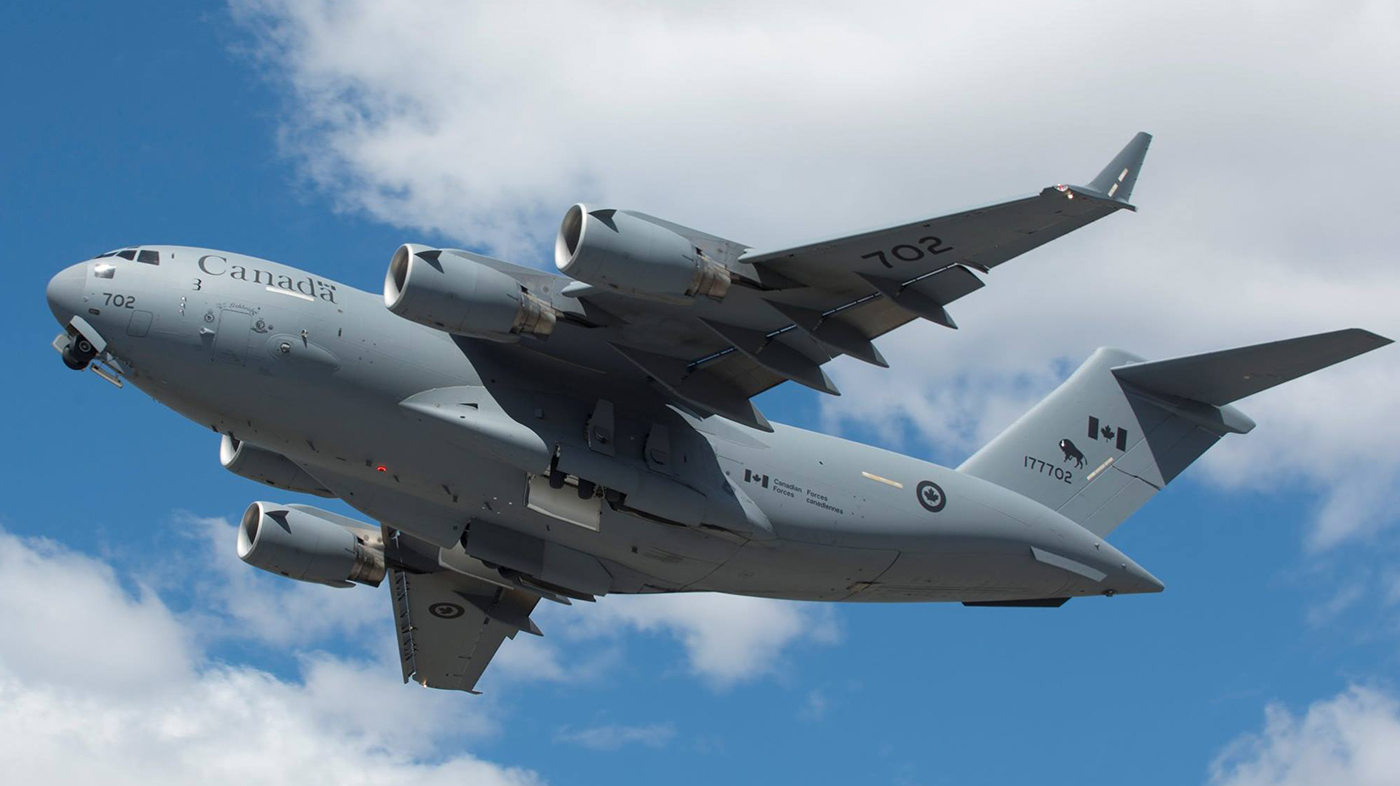
The U.S. Department of State has approved a possible Foreign Military Sale to the Government of Canada for sustainment services and related equipment in support of the Royal Canadian Air Force’s Boeing C-17 Globemaster III (CC-177 Globemaster III) fleet. The estimated total cost of the package is $540 million. Under the proposed sale, Canada has requested a comprehensive array of major and minor modifications, aircraft maintenance support equipment, ground handling equipment, spare parts, consumables and accessories, as well as repair and return services. The package also includes classified and unclassified software with delivery support, technical publications and documentation, and extensive U.S. Government and contractor engineering, technical, and logistics support services. Other related elements of logistics and program management are included to ensure continued fleet availability. Canada remains a key contributor to international stability, participating in a wide range of military, peacekeeping, and humanitarian missions worldwide. By sustaining its strategic airlift capability, the sale will help maintain Canada’s ability to project power and deliver aid rapidly across the globe, directly benefiting shared North American and alliance security interests.
The acquisition will enhance the operational readiness of the Royal Canadian Air Force’s CC-177 Globemaster III fleet, ensuring it can effectively meet both current and emerging threats. Canada’s C-17 aircraft provide critical strategic airlift that has repeatedly supported U.S. and coalition operations in multiple theaters. As an existing operator of the type, Canadian forces are expected to integrate the additional sustainment services and equipment without difficulty, leveraging established maintenance and training infrastructure. The principal contractor for the program will be The Boeing Company, based in Arlington, Virginia. Boeing has long supported the C-17 platform, which originated as a McDonnell Douglas design developed for the U.S. Air Force in the 1980s and early 1990s. The aircraft carries forward the Globemaster legacy and has become a cornerstone of tactical and strategic airlift, capable of transporting troops and heavy cargo, performing medical evacuations, and conducting airdrop operations. Beyond the United States, the C-17 serves the air forces of India, the United Kingdom, Australia, Canada, Qatar, the United Arab Emirates, Kuwait, and the multinational Heavy Airlift Wing based in Europe.
Canada’s requirement for robust strategic airlift capability evolved from repeated reliance on ad-hoc leasing arrangements. In previous years, the Canadian Armed Forces frequently chartered Antonov An-124 Ruslans and Ilyushin aircraft to support deployments, including Disaster Assistance Response Team missions and operations in Afghanistan and Haiti. These experiences highlighted the limitations of depending on foreign commercial providers and prompted the Future Strategic Airlifter Project in the early 2000s. The eventual procurement of C-17s provided Ottawa with a reliable, organic heavy-lift solution under national command. Since entering service, Canadian CC-177 Globemaster IIIs have proven their value across numerous operations. The aircraft have supported humanitarian efforts following the 2010 Haiti earthquake under Operation Hestia, facilitated logistics for Canadian missions in Afghanistan, and established vital air bridges after Typhoon Haiyan struck the Philippines in 2013. More recently, they have contributed to NATO’s Operation Reassurance and coalition efforts under Operation Impact, demonstrating the platform’s versatility in both combat support and disaster relief roles. The latest sustainment package will help ensure this proven capability remains available for future contingencies well into the coming decades.
The McDonnell Douglas/Boeing C-17 Globemaster III is a large military transport aircraft developed for the United States Air Force (USAF) during the 1980s and the early 1990s by McDonnell Douglas. The C-17 carries forward the name of two previous piston-engined military cargo aircraft, the Douglas C-74 Globemaster and the Douglas C-124 Globemaster II. The C-17 is based upon the YC-15, a smaller prototype airlifter designed during the 1970s. It was designed to replace the Lockheed C-141 Starlifter, and also fulfill some of the duties of the Lockheed C-5 Galaxy. The redesigned airlifter differs from the YC-15 in that it is larger and has swept wings and more powerful engines.The C-17 commonly performs tactical and strategic airlift missions, transporting troops and cargo throughout the world; additional roles include medical evacuation and airdrop duties. The transport is in service with the U.S. Air Force along with the air forces of India, the United Kingdom, Australia, Canada, Qatar, the United Arab Emirates, Kuwait, and the Europe-based multilateral organization Heavy Airlift Wing.


