


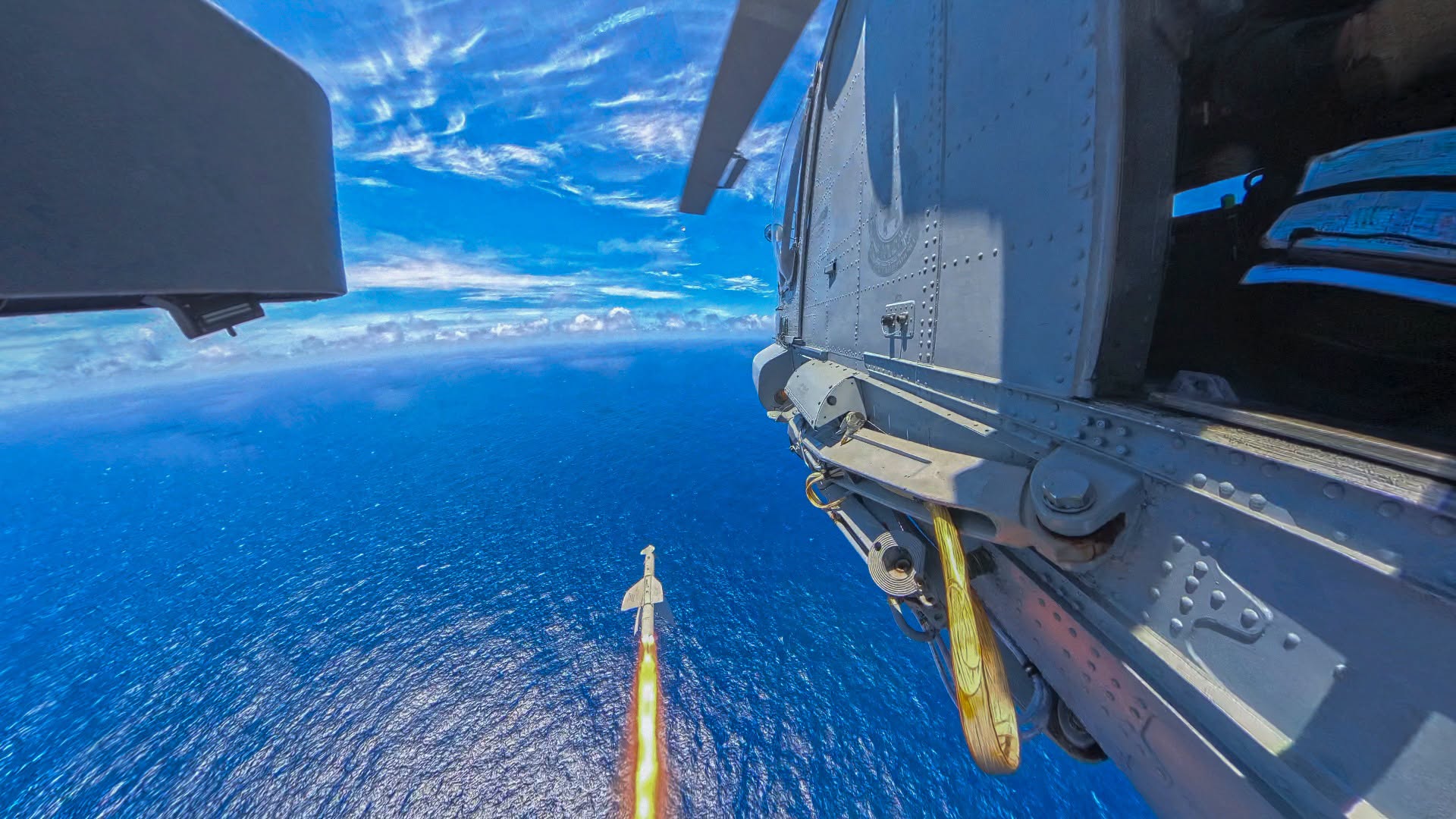
A Royal New Zealand Navy (RNZN) SH-2G(I) Super Seasprite maritime helicopter, deployed aboard the Anzac-class frigate HMNZS Te Mana (F111), has successfully executed a live anti-ship guided missile engagement during a Sinking Exercise (SINKEX) held as part of Exercise Rim of the Pacific (RIMPAC) off the coast of Hawaii. Operating in deep waters, the airborne platform targeted the decommissioned US Navy amphibious assault ship ex-USS Peleliu (LHA-5), releasing a solid-propellant AGM-119 Penguin anti-ship missile at high subsonic speed. The precision-guided munition performed as intended, penetrating the outer hull structure before its 120 kg (260 lb) high-explosive warhead detonated internally, inflicting severe structural damage, compromising the vessel’s hull integrity, and delivering critical real-world data regarding airborne anti-surface warfare (ASuW) capabilities against capital ship-sized threats.

The engagement underscores the operational utility of New Zealand’s fleet of eight SH-2G(I) Super Seasprite helicopters, operated by the RNZN’s No. 6 Squadron utilizing a unique force structure of RNZN aircrew—comprising a pilot, an observer specializing in warfare and mission command, and a loadmaster directing utility tasks—and Royal New Zealand Air Force (RNZAF) maintenance personnel. Originally developed by Kaman for the US Navy in the 1980s as an updated, re-engined iteration of the legacy 1960s SH-2 platform, the G-model evolved from the SH-2F to provide robust anti-submarine warfare (ASW) and ASuW organically from frigates incapable of embarking larger medium-lift aircraft. Delivered to New Zealand in 2015 to replace the older SH-2G(NZ) variant, these modern naval helicopters extend shipboard sensor and kinetic envelopes over the horizon, featuring four hardpoints capable of deploying AGM-119 Penguin missiles, AGM-65D Maverick air-to-ground missiles, Mk 46 or Mk 50 torpedoes, and a door-mounted FN MAG 58 7.62 mm general-purpose machine gun.

At the core of the Seasprite’s anti-surface strike capability is the Norwegian-designed AGM-119 Penguin, an all-weather, short-to-medium-range anti-ship missile utilizing a passive infrared (IR) terminal seeker and inertial mid-course guidance. Designed to operate in high-clutter coastal environments as well as open sea, the Penguin allows the launching platform to immediately break away after release while the missile autonomously negotiates its flight path. Advanced variants can execute sea-skimming approaches with random waypoints and terminal pop-up or weaving maneuvers, striking the target precisely at the waterline to maximize hydrodynamic displacement. The missile’s warhead—derived from the AGM-12 Bullpup design and fitted with a delay-action fuze—ensures internal penetration before detonation, rendering it a lethal countermeasure against surface combatants and patrol craft.

This live-fire event at RIMPAC highlights the multi-role mission flexibility of the SH-2G(I) within the New Zealand Defence Force (NZDF) operational domain. Beyond their primary combat roles in anti-surface strike, anti-submarine warfare, and maritime surveillance from embarked combatants including HMNZ Ships Te Kaha, Te Mana, Aotearoa, Canterbury, Wellington, and Otago, the fleet performs extensive secondary operations. These encompass search and rescue (SAR), winching, utility load lifting, interdiction, and supporting domestic missions for civil agencies such as the Department of Conservation and Ministry for Primary Industries. By evaluating airborne anti-ship munitions against decommissioned combat vessels in realistic multi-national SINKEX scenarios, coalition forces continue to validate precision strike tactics and warhead effectiveness against modern surface threats.


