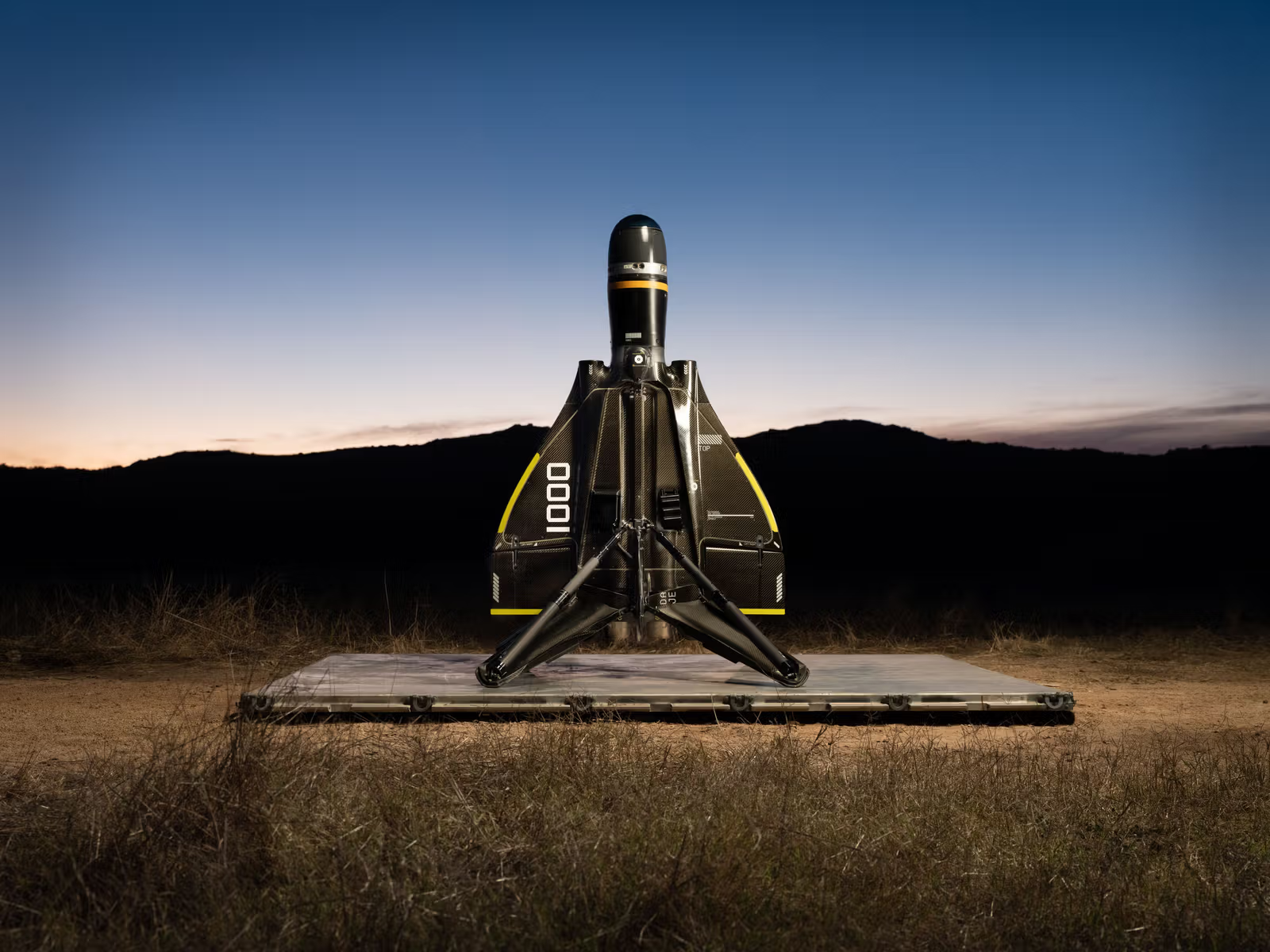
The US State Department has cleared a potential Foreign Military Sale (FMS) to the Government of Kuwait for counter-unmanned aerial systems (C-UAS) platforms, signaling a major Gulf push for Anduril Industries’ autonomous air defense hardware. According to a State Department notification released in June 2026, the proposed deal seeks to address Kuwait’s critical air defense gaps against low-cost, asymmetric threats. The Government of Kuwait has requested to buy counter-unmanned aerial systems platforms. The following non-major defense equipment items will be included: counter-unmanned aerial systems platforms Roadrunner-Munition and Anvil-Kinetic; Lattice command and control; Long Range Sentry Tower with Fire Control; Long Range Sentry Tower-82 Mobile; Extended Range Sentry Towers; Maritime Sentry Towers; pulsar electromagnetic warfare; menace tactical operations centers and other related elements of logistics and program support. While the official release did not provide a granular breakdown of the system quantities, the procurement package heavily leverages Anduril’s autonomous, AI-driven portfolio, anchored by the Roadrunner twin-jet vertical takeoff and landing (VTOL) autonomous air vehicle (AAV).

The cornerstone of the proposed acquisition is the Roadrunner-M, the high-explosive interceptor variant designed specifically for ground-based air defense (GBAD). Developed by Anduril as a private venture from concept to operational validation in under two years, the Roadrunner platform utilizes a modular, twin-jet architecture capable of high subsonic speeds paired with high agility. Industry sources indicate that the choice of Roadrunner-M reflects Kuwait’s requirement for a flexible, multi-echelon layer to counter regional Group 3+ UAS threats. Unlike traditional, legacy surface-to-air missile (SAM) systems, the Roadrunner-M offers a “launch-on-alert” capability similar to scrambling manned interceptors but at a fraction of the cost. If an aerial threat is deemed benign or handled by other assets, the craft can abort engagement, return to a pre-designated point, land vertically, and be refueled for immediate reuse—offering a near-zero marginal cost for unconsumed interceptors. The Roadrunner-M possesses distinct performance advantages over current market alternatives, including a threefold increase in warhead payload capacity, a tenfold increase in one-way effective range, and three times the structural G-force maneuverability.

In addition to the high-subsonic Roadrunner, the procurement architecture is expected to include Anduril’s Anvil, a high-speed, autonomous kinetic interceptor optimized to seek and destroy smaller, low-altitude Group 1 and Group 2 drone threats via physical ramming. To cue these kinetic effectors, the package incorporates Anduril’s Sentry family of autonomous sensor systems. The Sentry towers operate as force multipliers, utilizing edge-processed machine learning and computer vision algorithms to detect, identify, and track targets across complex sectors. By processing data at the edge, Sentry generates tailored threat alerts within seconds, drastically reducing operator cognitive load and compressing the sensor-to-shooter kill chain. Central to the operational deployment of Kuwait’s future C-UAS ecosystem is Anduril’s Lattice software suite. Lattice acts as an AI-powered command-and-control (C2) layer that enables a single human operator to manage and supervise multiple squadrons of Roadrunner or Roadrunner-M vehicles simultaneously. Crucially for regional interoperability, the system is designed with an open architecture format, allowing it to be integrated directly into Kuwait’s legacy air defense radars, early warning networks, and existing command structures.

Anduril Industries, Inc. is an American military technology company specializing in the development of advanced autonomous systems. The company was founded in 2017 by Palmer Luckey, Trae Stephens, Matt Grim, Joe Chen, and Brian Schimpf. Anduril sells systems to the U.S. Department of Defense that incorporates artificial intelligence and robotics. Anduril’s major products include unmanned aerial systems (UAS) and counter-UAS (CUAS), semi-portable autonomous surveillance systems, and networked command and control software. It is privately owned, and as of May 2026, the company has a valuation of $61 billion. Anduril is headquartered in Costa Mesa, California, with satellite offices in Boston, Atlanta, Seattle, Washington, D.C., London, and Sydney. The company chose to base itself in Irvine due to its proximity to military bases and to stay away from Silicon Valley, which has been more cautious about working for the military. The company must use industrial equipment to build their products, has security requirements for classified contracts, and supplies in-person demonstrations for potential clients.