


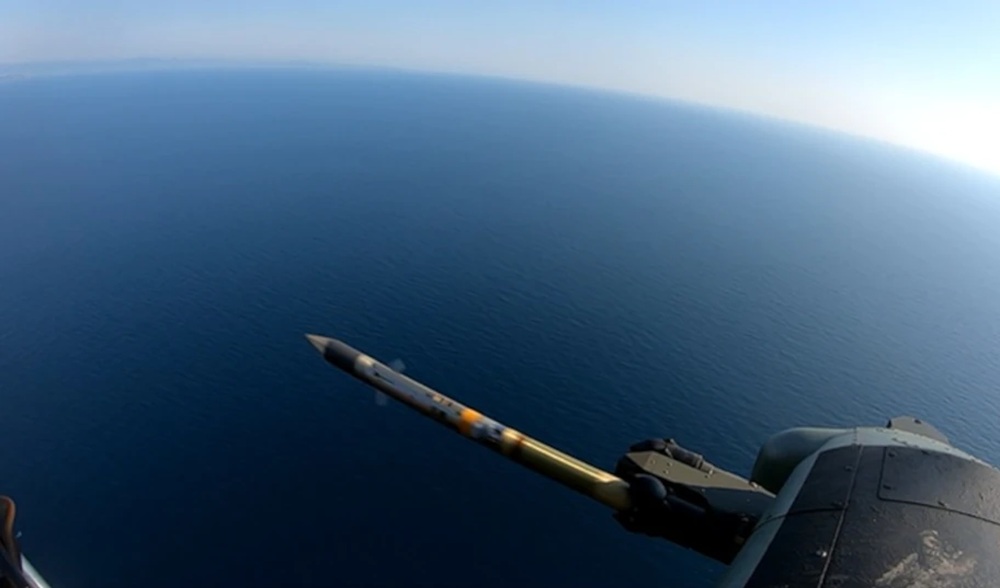
Against a backdrop of evolving threats and growing operational requirements, the DGA (Directorate General of Armaments) called upon MBDA to rapidly integrate an anti-drone capability for the Tigre MK2 attack helicopter. MBDA rose to the challenge, delivering a solution that enabled the first use of the MISTRAL 3 on the Tigre MK2 in record time. This advancement strengthens the defence and interception capabilities of the French Armed Forces. This integration test campaign for the MISTRAL 3 missile on the Tigre MK2 helicopter is a resounding success, having delivered under tight time constraints, a software and technical evolution of the MISTRAL 2 firing system already present on the Tigre MK2. This enabled both the carriage and the execution of a live fire. Effective coordination between MBDA, the DGA, and the Armed Forces made it possible to overcome the technical challenges associated with integrating the MISTRAL 3 onto the Tigre MK2 helicopter within a record timeframe.
The Mistral (Missile Transportable Anti-aérien Léger (Transportable lightweight anti-air missile) is a family of French infrared homing multipurpose short range air defense system manufactured by MBDA France (formerly by Matra Défense and then Matra BAe Dynamics). Based on the French SATCP (‘Sol-Air à Très Courte Portée’), the development of the portable system that would later become the Mistral began in 1974. The first version of the system was introduced in 1990 (Mistral 1), the second in 1998 (Mistral 2), and the third in 2013 (Mistral 3). Mistral is a short-range air defence (SHORAD) missile system that can be used from vehicles, surface ships, and helicopters, as well as in a portable configuration. The “Mistral” missile is transported in a transport and launch container (MPC) together with a “friend or foe” interrogator, a power source and a tripod with its sighting devices. There are also launch units that allow the missile to be fired from armoured vehicles, ships or helicopters (such as the Aérospatiale Gazelle, Denel Rooivalk, or Eurocopter Tiger).

This integration test campaign for the MISTRAL 3 missile on the Tigre MK2 helicopter was successfully conducted, thereby confirming the missile’s performance. The urgent need to increase French anti-drone capabilities, combined with the commitment of all parties involved, made it possible to accelerate the integration process and add new functionalities within a very short period. This represents a significant improvement for the platform, as the Tigre MK2 was already using MISTRAL 2, the transition to MISTRAL 3 allows it to increase its interception capabilities to deal more effectively with a variety of emerging aerial threats. MBDA has once again demonstrated its ability to accelerate and support operational ramp-up by providing cutting-edge solutions to meet the needs of the Armed Forces and counter new threats. The MISTRAL is a versatile, multi-domain, multi-platform missile, perfectly adapted to current and future threats, offering comprehensive protection against a wide range of aerial dangers.
The EC665 Tiger, is a four-blade, twin-engine attack helicopter which first entered service in 2003. It is manufactured by Airbus Helicopters, formerly Eurocopter, which arose from the merger of Aérospatiale’s and DASA’s respective helicopter divisions. Airbus Helicopters designates it as the EC665. In France and Spain, the helicopter is known as the Tigre (which is French and Spanish for Tiger), while in Germany and Australia it is referred to as the Tiger. The Tiger has the distinction of being the first all-composite helicopter developed in Europe; even the earliest models also incorporate other advanced features such as a glass cockpit, stealth technology, and high agility to increase its survivability. The Tiger can be fitted with various armaments including rockets, cannons, and a range of air-to-air and air-to-surface missiles, controlled via a dedicated weapons control computer. When deploying missiles such as the Mistral, the Tiger is capable of taking advantage of the munition’s off-boresight capabilities.


