


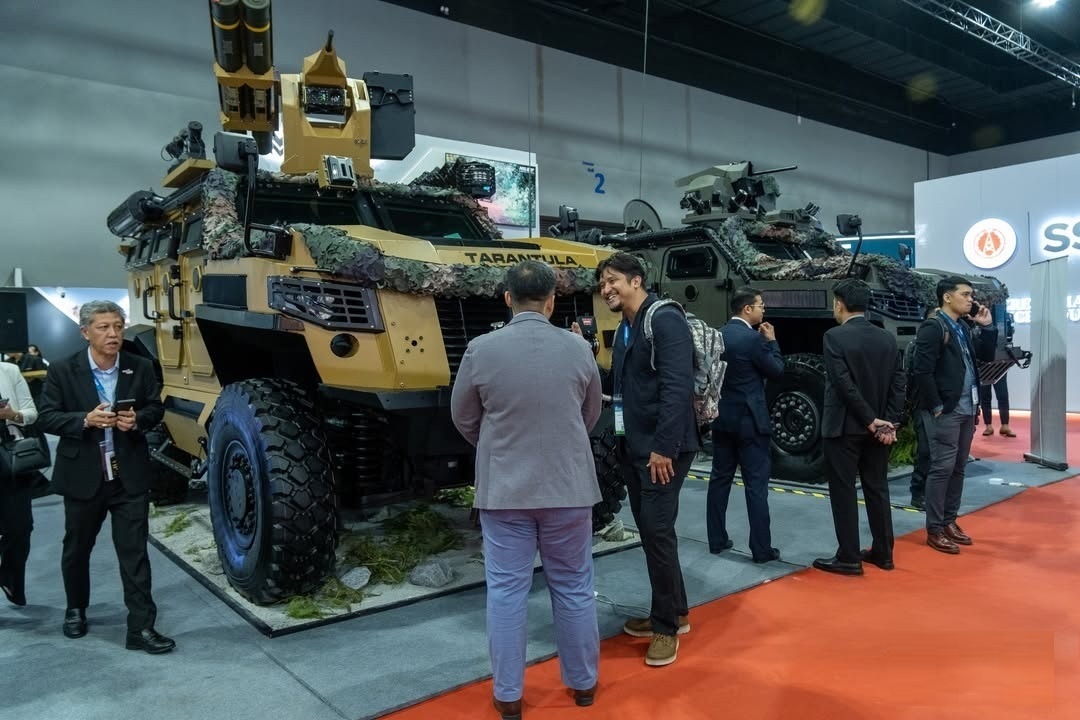
Malaysian defense company Mildef International Technologies has unveiled an upgraded variant of its Tarantula high-mobility armoured vehicle (HMAV) at the Defence Services Asia 2026 exhibition in Kuala Lumpur. The upgraded Tarantula was presented as a technology demonstrator and prototype during the exhibition, which was held from 20–23 April, and is intended to highlight Mildef’s capability to integrate mission-specific weapon systems in accordance with customer requirements. Alongside the upgraded demonstrator, Mildef also exhibited the baseline Tarantula configuration currently being produced for the Malaysian Army under a contract for 136 vehicles. Deliveries are scheduled over a five-year period, with the first batch expected by the end of 2026. The company said it is already preparing its production facilities for serial manufacture.
The configuration displayed at DSA 2026 is fitted with a Sistem SARP turret supplied by Roketsan, armed with a 12.7 mm heavy machine gun and two launchers for the OMTAS anti-tank guided missile (ATGM). OMTAS, also known as Mızrak-O, is a Turkish-developed medium-range ATGM designed for engaging armoured targets at extended ranges. The missile forms part of Malaysia’s broader procurement of Turkish anti-armour systems, alongside the short-range Karaok missile. Karaok (Black Arrow) is also a 125 mm manportable, lightweight, fire-and-forget, short-range anti-tank guided missile (ATGM) in development by Roketsan. Previous reports indicate that the Malaysian Army has ordered 18 launchers and 108 missiles for integration onto the Cendana Auto 4×4 platform.
According to Mildef, This weaponised Tarantula configuration is being proposed to the Malaysian Army as a potential future requirement. Mildef said the Tarantula has been developed to meet current United Nations operational standards and is intended to provide the Malaysian Armed Forces with a domestically produced, modular, and exportable 4×4 armoured vehicle platform. The in-service variant is equipped with a range of integrated subsystems, including a 12.7 mm Stabilised Advanced Remote Weapon Platform (SARP) remote-controlled weapon station, laser warning systems, driver vision systems, a battle management system, and communications equipment covering very high frequency (VHF), ultra-high frequency (UHF), and high frequency (HF) bands.
The Tarantula platform has an overall length of approximately 5.9–6.3 m, a width of 2.5 m, and a height of between 2.5 m and 3.0 m depending on configuration. Combat weight is reported at around 14 tonnes, with a maximum gross vehicle weight (GVW) of 16 tonnes. The vehicle is powered by a six-cylinder turbocharged diesel engine—reportedly based on a Caterpillar powerpack—delivering a power-to-weight ratio of between 21 hp/tonne and 25 hp/tonne. Performance figures released by the company indicate a top road speed of between 110 km/h and 120 km/h and an operational range of 600–700 km. Mobility characteristics include a 60% gradient climb capability, 30% side-slope traversal, 500 mm vertical obstacle clearance, 700 mm trench-crossing capability, and 1,000 mm fording depth.The Tarantula has been qualified to NATO STANAG 4569 standards, with ballistic protection rated to Level 2 and mine protection to Level 2A/2B. The platform uses composite armour, mine-blast attenuating seats, and underbelly blast protection to improve crew survivability.


