


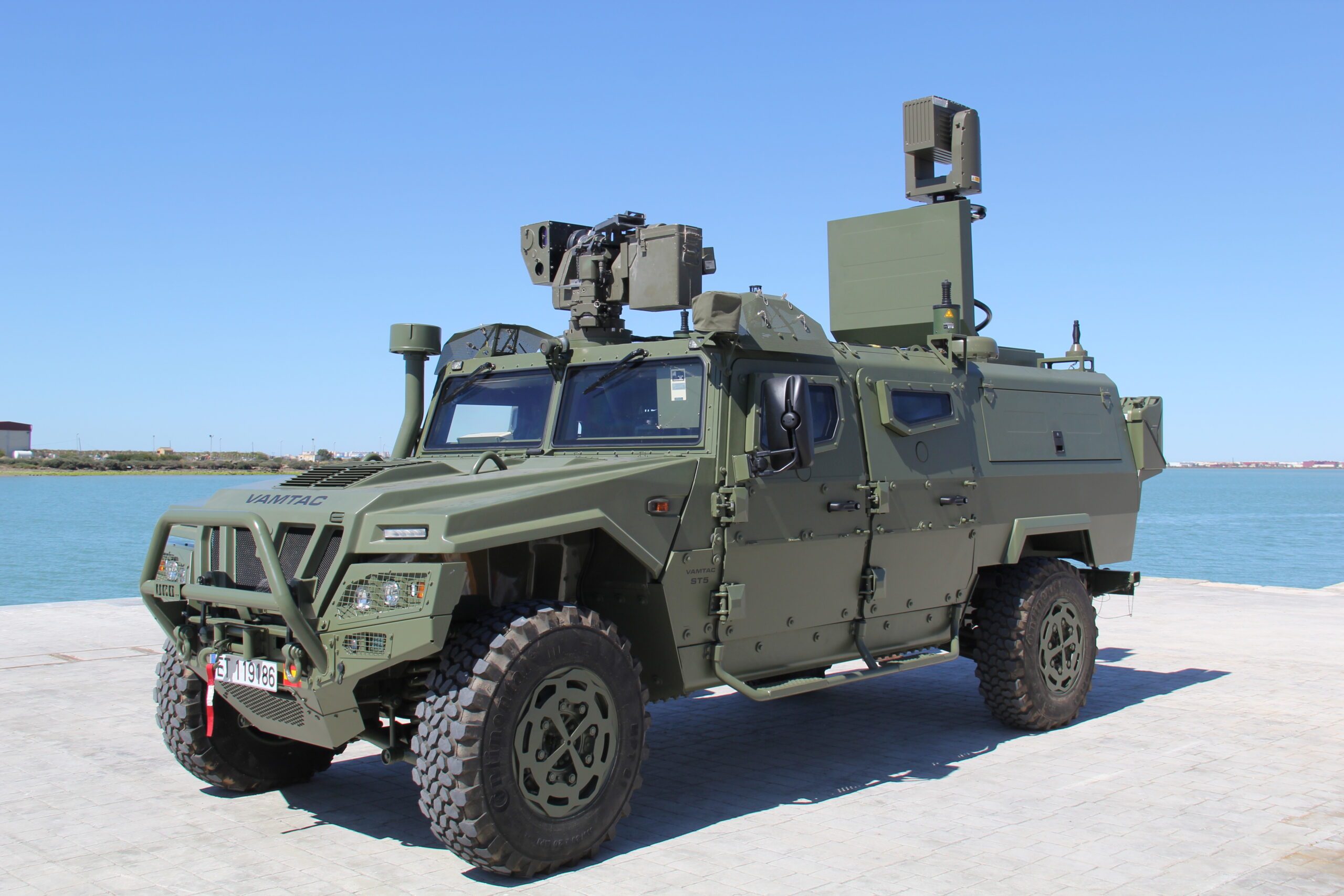
UROVESA and Navantia have signed a contract to integrate 100 SERT suites into the Spanish Army’s VAMTAC ST5 4×4 vehicles under Phase II of the VERT (Vehículo de Exploración y Reconocimiento Terrestre) program. The agreement, awarded by Spain’s Dirección General de Armamento y Material (DGAM) with UROVESA as prime contractor, advances the Army’s modernization of its reconnaissance capabilities with enhanced optronic sensors and networked systems. The VERT program integrates Navantia’s SERT system — centered on an optronic pedestal mounted on a deployable mast — into UROVESA’s proven VAMTAC ST5 platform. Phase I, contracted in 2014, delivered 16 vehicles that demonstrated strong operational performance. Phase II calls for the delivery of an additional 100 VERT vehicles between 2026 and 2030, incorporating design refinements and upgraded technological integration to meet evolving operational requirements.
This latest contract marks a significant step in maturing a national solution tailored to the increasingly complex demands of modern land operations. It also reinforces the strategic partnership between two of Spain’s leading defense firms, combining UROVESA’s expertise in tactical vehicle design and lifecycle support with Navantia’s experience in complex sensor integration, combat system architecture, and information management extended into the land domain. UROVESA leads platform development, contributing its established capabilities in mobility, protection, and reliability for high-intensity tactical environments. Navantia supplies the core SERT sensor suite and associated systems, applying its naval-derived strengths in sensor fusion, data handling, and secure communications to create a highly capable ground reconnaissance vehicle.

Within Spanish Army Cavalry Groups, the VERT is designed to conduct both close combat reconnaissance and deeper exploitation missions, as well as provide tactical security for supported brigades. Operating in close proximity to enemy forces and civilian populations, the vehicles emphasize mobility, extended range, and the critical “see without being seen” concept through advanced sensors and low-observability features. The system features a modular, scalable architecture that allows integration of various mission packages. Phase II will further refine technical specifications, with emphasis on next-generation sensors, advanced data management and exploitation, secure communications, platform digitization, and improved interoperability across joint and allied forces. These enhancements aim to maximize operational effectiveness while enhancing crew survivability.
The VERT measures 5.9 meters in length, 2.9 meters in width, and 2.3 meters in height (excluding the remote weapon station). It has a maximum combat weight of 9,950 kg and is powered by a 160 kW (217 hp) diesel engine coupled to an automatic transmission with permanent all-wheel drive. The vehicle achieves a maximum road speed of 118 km/h, can climb 60 percent longitudinal gradients and 30 percent side slopes, and carries a crew of four: vehicle commander, driver, SERT operator, and remote weapon station operator. It is typically armed with a 12.7 mm heavy machine gun. Primary observation capabilities include the ability to detect and identify dismounted personnel at ranges of at least 4,050 meters and vehicles at 7,050 meters, providing the Spanish Army with a potent day/night, all-weather reconnaissance asset well suited to both high-intensity conflict and stabilization operations.


