


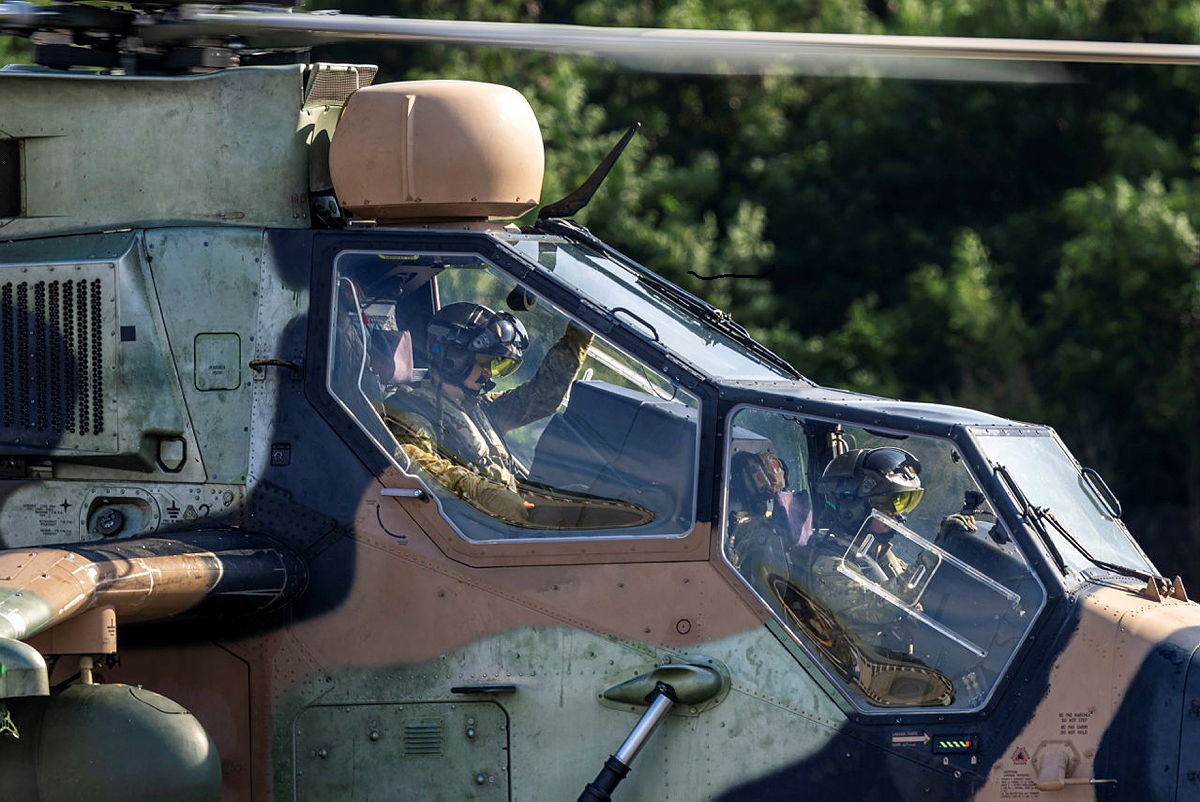
The Australian Army has deployed Armed Reconnaissance Helicopters (ARH) to Malaysia as part of Exercise Keris Strike 26, marking a significant escalation in operational scale and combined-arms integration for the annual multilateral exercise. Personnel from Task Unit Marlin—primarily drawn from the Darwin-based 162 Reconnaissance Squadron of the 1st Aviation Regiment—joined ground forces from the 2/30 Training Group for a three-week tactical training rotation in July. Led by Commanding Officer Lt. Col. Adam Seary, the Australian contingent transitioned from traditional Rifle Company Butterworth infantry deployments into a comprehensive combined-arms regional combat team. Operating in the challenging environment of Kota Belud, the deployment showcased the organic fire support, armed escort, and offensive reconnaissance capabilities of the Eurocopter EC665 Tiger ARH, bolstering Australia’s power-projection capacity and military footprint within Southeast Asia alongside host nation forces and US Army units.

Tactical air support and vertical maneuver elements during the exercise were structured under a combined aviation task force led by the US Army’s 2nd Combat Aviation Brigade (Task Force Nightcard), commanded by Lt. Col. Mike Poling. Operating alongside Australian Tigers, the US aviation contingent committed UH-60M Black Hawk utility helicopters and specialized HH-60M medical evacuation (MEDEVAC) platforms, enabling joint air assault, cargo movement, and casualty evacuation drills. US National Guard elements, including troops under Brig. Gen. Karin Watson of the Guam National Guard, utilized the expansive maneuver space at Kota Belud to conduct complex live-fire exercises that are constrained by land availability at home station. The multi-national aviation framework integrated flight profiles, standardized tactical communications, and refined tactics, techniques, and procedures (TTPs) across combined aircrews, sharpening operational readiness in austere, non-garrison tropical environments.

Interoperability and coalition alignment served as primary focal points throughout the exercise, fostering enhanced cohesion among Australian, Malaysian, and US defense personnel. Task Unit Marlin commander Maj. Rhys Davies highlighted the smooth integration between Australian aviation assets and US doctrine, emphasizing the plug-and-play capability developed through regular combined training frameworks. Beyond high-end tactical engagement, joint logistics support from the Malaysian Armed Forces and local civilian agencies played a key role in sustaining force projection throughout the training area. Operational commanders noted that shared logistical and environmental hardships faced in the field build foundational operational trust, ensuring rapid interoperability during potential contingency operations, contingency response, or regional humanitarian assistance and disaster relief (HADR) missions across the Indo-Pacific theater.

Exercise Keris Strike 26 culminated in a synchronized multi-domain live-fire demonstration integrating ground-based infantry maneuvers, tube artillery fires, and aviation strike packages from both Tiger ARHs and armed Black Hawks. The Australian Tiger ARH—a heavily modified variant of the Tiger HAP powered by upgraded MTR390 engines, featuring a Strix roof-mounted sight with integrated laser designator for AGM-114 Hellfire II air-to-ground missiles and 70 mm rockets—demonstrated precision aerial firepower during the combined assault phase. The successful execution comes as the Australian Defence Force executes its broader rotary-wing fleet modernization strategy. Having announced the accelerated retirement of the Tiger fleet by late 2026, the Australian Army is preparing for the incoming delivery of Boeing AH-64E Apache Guardian attack helicopters to the 1st Aviation Regiment through 2029, ensuring continuity of attack aviation capabilities within the Australian Defence Force.


