


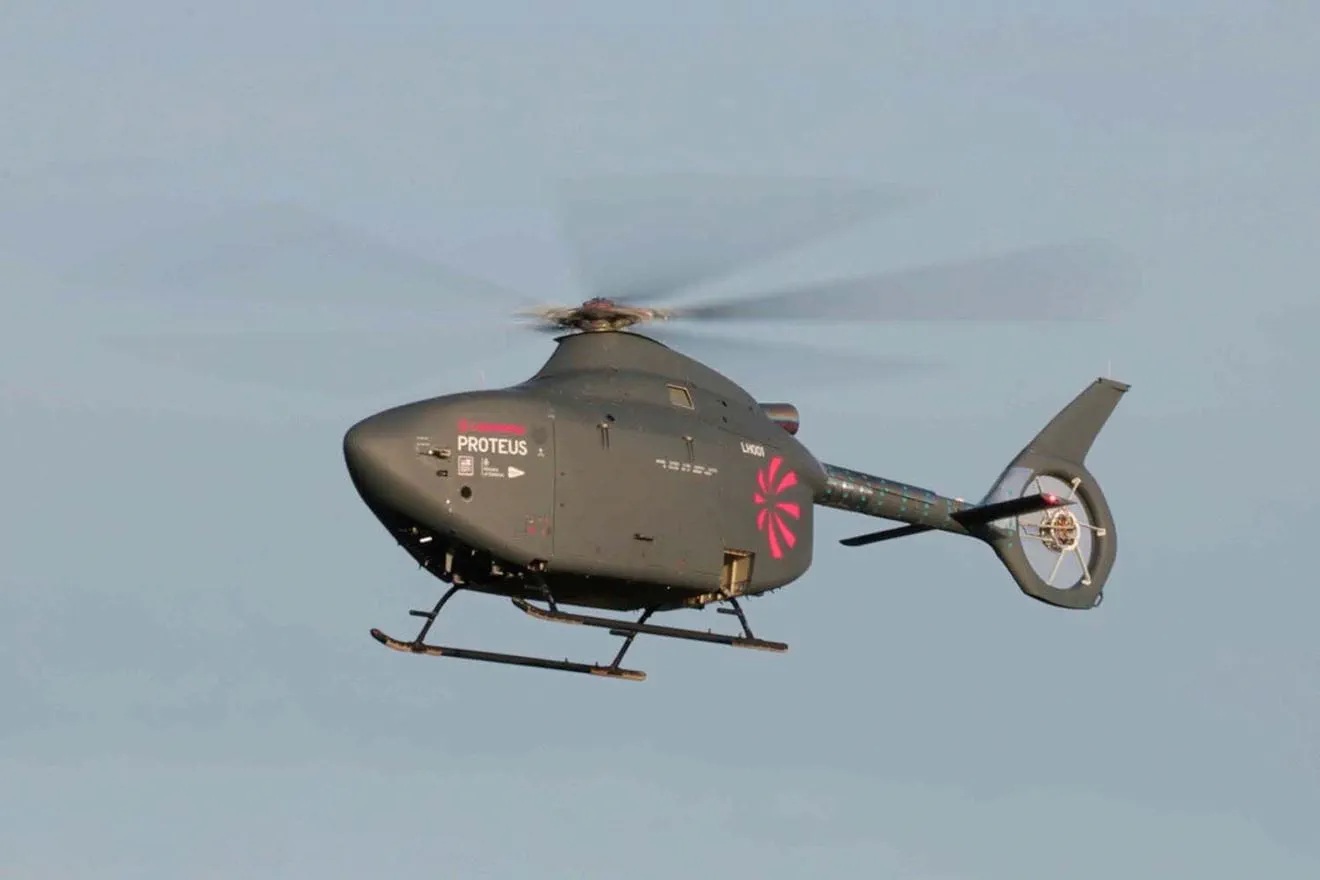
In a major technical milestone for the United Kingdom’s future naval aviation roadmap, the Royal Navy’s first heavy uncrewed technology demonstrator helicopter, designated Proteus, successfully completed its initial flight operations at Predannack Airfield in Cornwall. Designed, developed, and manufactured by Leonardo at its flagship rotary-wing facility in Yeovil, the 3-tonne-class Rotary Wing Uncrewed Air System (RWUAS) marks a pivotal step in proving high-level autonomous vertical take-off and landing capability for harsh maritime operational environments. The flight demonstration represents the operational culmination of a four-year, GBP60 million (USD78 million) contract awarded to Leonardo in July 2022 under the UK Ministry of Defence’s RWUAS Phase 3A Technology Demonstrator Programme.
The Proteus aircraft serves as an advanced flight testbed specifically designed to evaluate high-order autonomy, open-architecture systems, and rapid payload modularity. Jointly managed by Leonardo’s Future Programmes Group and the Ministry of Defence’s Defence Equipment & Support Future Capability Innovation team, the platform incorporates an agile development framework aimed at accelerating the transition of emerging aviation technologies into frontline service. By testing reconfigurable mission systems in real-world flight regimes, the program intends to validate how large uncrewed air systems can effectively augment crewed fleet platforms, taking on high-risk, long-endurance sorties across primary mission sets including persistent anti-submarine warfare, maritime intelligence, surveillance, and reconnaissance, as well as ship-to-ship tactical logistics.

Strategically, the platform forms a core operational pillar supporting the Royal Navy’s overarching Maritime Aviation Transformation initiative, as well as the broader Fleet Air Arm 2040 vision and the UK Defence Capability Framework. Funded primarily through the Royal Navy’s Anti-Submarine Warfare Spearhead Programme, the demonstrator addresses the pressing requirement to build operational mass at sea without proportionally increasing human crew burdens or lifecycle costs. By deploying autonomous rotary-wing systems alongside conventional crewed aircraft, defense planners aim to significantly extend outer-screen domain awareness, maintain continuous underwater tracking capabilities, and project force more flexibly in contested blue-water and littoral environments.
This milestone reflects over a decade of continuous research and development collaboration between Leonardo, the Royal Navy, and UK defense acquisition authorities focused on advanced uncrewed rotorcraft technologies. The flight-test campaign now underway in Cornwall will generate critical empirical data, proving that existing military aviation concepts can be successfully enhanced through integrated autonomous assets. The evidence gathered from Proteus operations will directly inform the UK Ministry of Defence’s future procurement strategies and design requirements, laying the technological foundation for the Royal Navy’s next-generation operational fleet of autonomous rotary-wing aircraft.


