


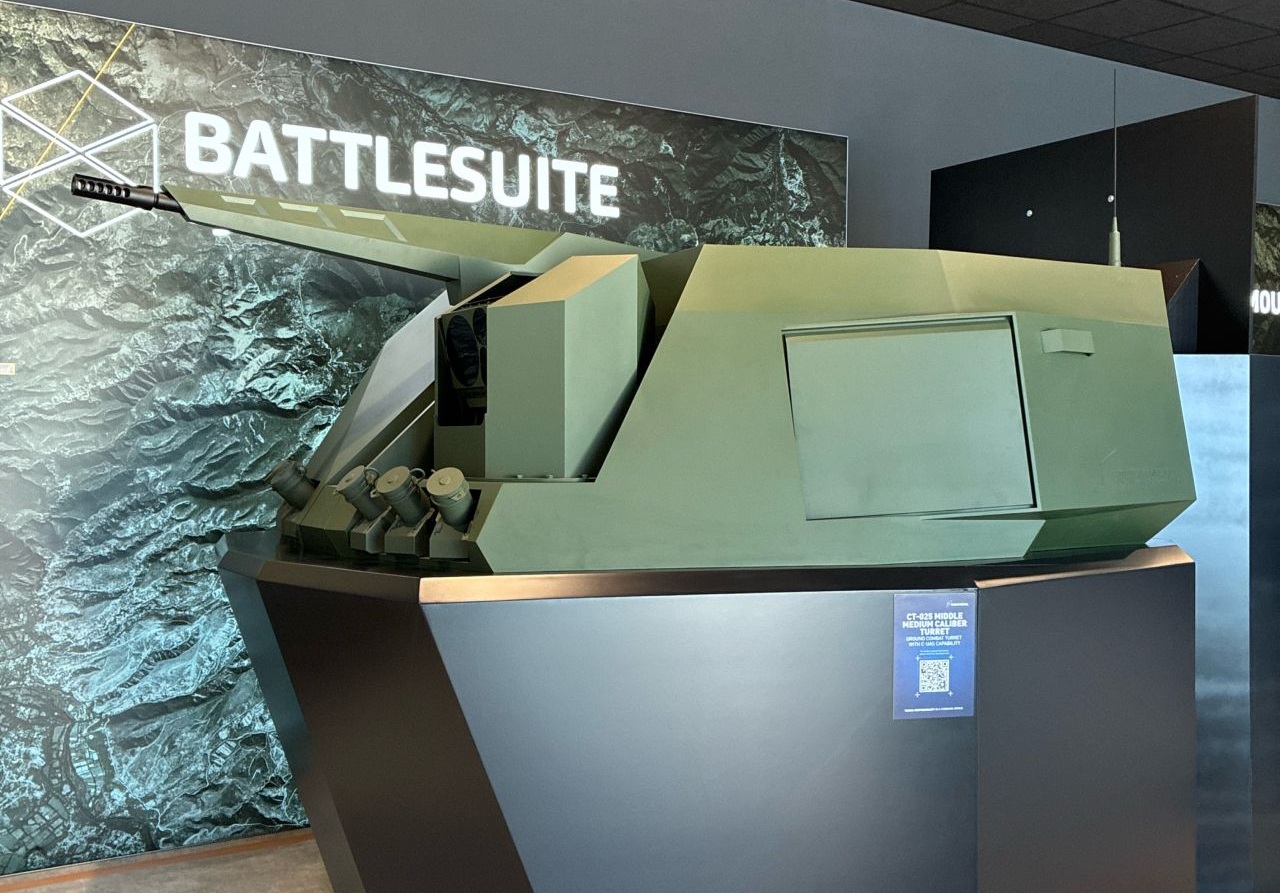
Rheinmetall has expanded its portfolio of medium-caliber weapon systems at the Eurosatory 2026 defense exhibition in Paris by introducing the new CT-025 20 modular unmanned turret family, engineered for reconnaissance, force protection, and asymmetric threat engagement. Designed for seamless integration across a broad spectrum of manned and unmanned combat vehicles, the lightweight and compact remote-controlled turret architecture addresses emerging multi-domain mission profiles, including counter-unmanned aircraft system (C-UAS) operations, perimeter security, and critical asset protection. By removing crew requirements from the turret structure, the system enhances operator survivability in contested operational environments while maximizing strategic mobility, tactical flexibility, and platform compatibility without sacrificing organic lethality or sensor performance.
The core configuration of the series is the CT-025 20, an advanced sensor-enabled unmanned variant that combines the proven Rheinmetall KBA 25 mm automatic cannon with a highly sophisticated, multi-domain surveillance suite. The primary effector delivers a rate of fire of up to 600 rounds per minute and boasts an effective range of up to 2,500 meters utilizing a dual-belt feed mechanism that supports multiple ammunition types for rapid engagement adaptability against diverse target sets. Secondary lethality and defensive systems can be expanded via an optional coaxial 5.56 mm or 7.62 mm NATO machine gun, alongside the integration of Rheinmetall’s ROSY smoke protection launchers, acoustic platforms, surveillance camera modules, and laser warning systems to achieve up to NATO STANAG Level 2+ ballistic protection thresholds.

Central to the target acquisition capability of the CT-025 20 is the integration of Rheinmetall’s high-performance SEOSS 320 stabilized electro-optical/infrared sensor package alongside a planned three-dimensional Active Electronically Scanned Array radar system. This dual-sensor architecture is specifically optimized for complex asymmetric environments, providing simultaneous multi-target processing and automatic aerial and ground target tracking of low, slow, and small signatures. Performance metrics for the SEOSS 320 include a detection range exceeding 17,000 meters for standard NATO targets and 4,000 meters for micro-UAVs, complemented by the integrated AESA radar which provides real-time 3D situational awareness data and threat evaluation by detecting micro-UAVs at distances over 2,300 meters.
For more agile reconnaissance and maneuver roles, Rheinmetall offers the lighter CT-025 10 variant, which integrates the compact SEOSS 210 electro-optical sensor suite to prioritize high mobility and rapid deployment capability. While more streamlined, the CT-025 10 remains highly capable, offering standard NATO target detection at ranges out to 8,000 meters and identification capabilities up to 3,500 meters, alongside a micro-UAV detection envelope exceeding 700 meters. Both variants employ a fully digital, inertially stabilized fire-control system that incorporates advanced ballistic computations and artificial intelligence-ready target tracking algorithms, enabling precise hunter-killer operations and highly accurate threat engagement while the platform is moving.

The entire product line is built upon a fully digital open-system architecture designed to comply with NATO Generic Vehicle Architecture standards, ensuring plug-and-play interoperability across modern combat ecosystems. This digital backbone facilitates seamless vehicle integration for legacy fleets, next-generation tactical wheeled and tracked platforms, and autonomous unmanned ground vehicles without requiring extensive hardware alterations. Furthermore, the software-defined functionality of the system accommodates future cloud-based maintenance protocols, remote diagnostics, and over-the-air software updates, which significantly reduces lifecycle complexity and streamlines logistics management for expeditionary forces.
By offering scalable sensor and effector configurations through this highly modular framework, the CT-025 family provides defense forces with a future-proof solution capable of rapid adaptation to evolving multi-domain threats and hybrid force structures. The inherent flexibility of the architecture supports specific mission packages for diverse operational environments, spanning moving convoy protection, forward operating base defense, and automated perimeter security. Ultimately, Rheinmetall’s latest unmanned turret innovation positions itself as a critical enabler for modern network-centric warfare, bridging the gap between current legacy vehicle capabilities and future automated, manned-unmanned teaming operational concepts.


