


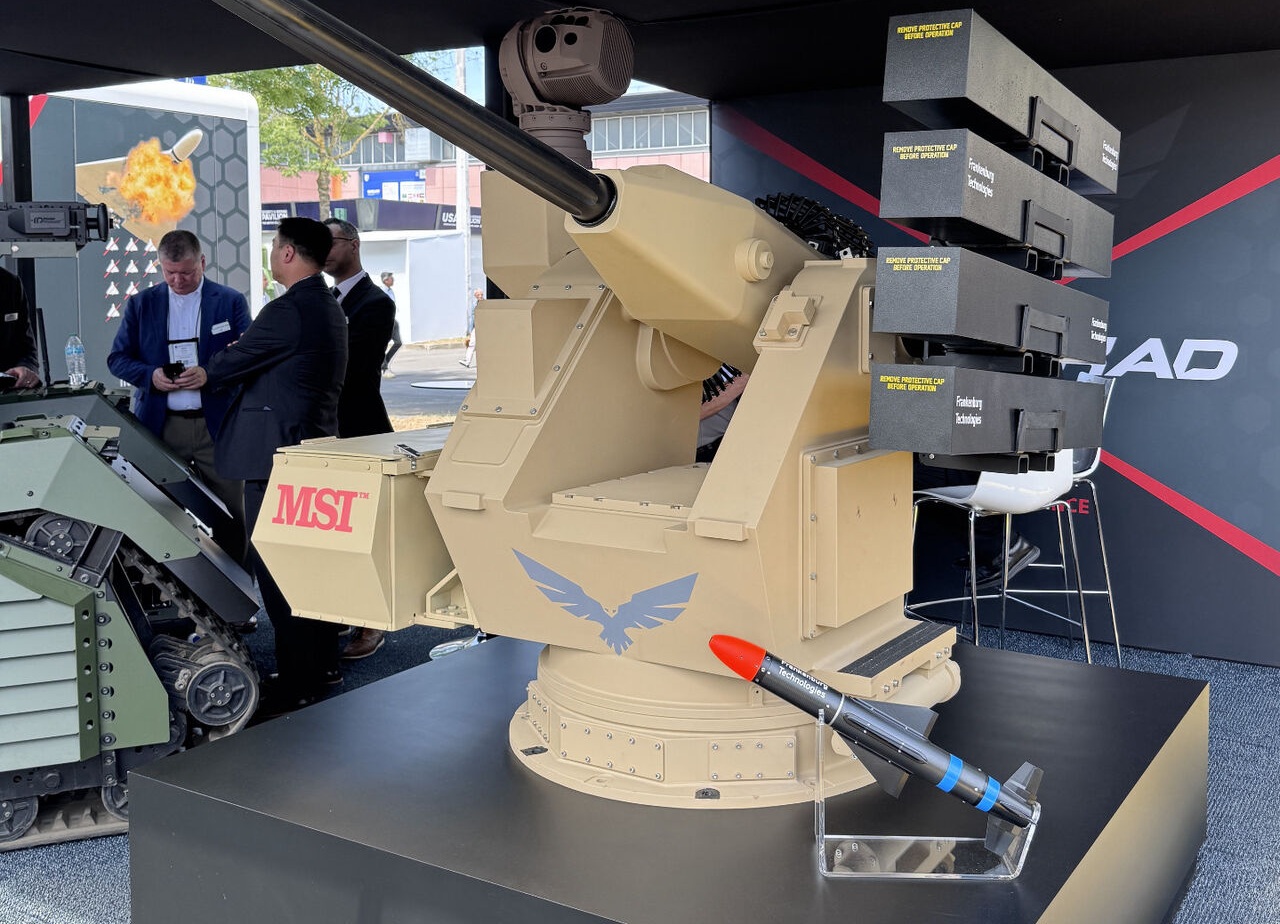
At the Eurosatory 2026 defense exhibition, European defense technology company Frankenburg Technologies showcased its Mark I guided air defense missile, presenting the low-cost, mass-manufacturable interceptor across several operational platform contexts. Designed specifically to counter Class I–III unmanned aerial systems (UAS) and drone swarms, the Mark I was displayed alongside Airbus Defence and Space’s Bird of Prey air platform, MSI-Defence Systems’ layered air defense solution, MARSS Group’s counter-UAS (C-UAS) platform, and a mobile robotic system developed in cooperation with Milrem Robotics. The system’s operational viability was demonstrated in December 2025 during a live-fire trial at the Ādaži NATO training area in Latvia, where the fire-and-forget missile successfully intercepted a moving Class III UAS target. Developed from concept to live-fire intercept in just 13 months, the Mark I claims the distinction of being the smallest and lowest-cost guided interceptor missile ever live-fired.

The platform-agnostic effector is engineered to integrate seamlessly with third-party partner sensors, launch systems, and battle-management software across land, air, and maritime domains. Measuring 0.65 m in length and weighing under 2 kg, the solid-fuel rocket-powered missile operates at high subsonic speeds and utilizes a proximity-fuzed warhead to neutralize threats within a range of less than 2 km, targeting both slow, one-way propeller drones running at 150–200 km/h and faster jet-powered threats traveling between 450–600 km/h. For ground applications, the Mark I can be deployed from a compact, manually handled four-canister launcher designed for rapid field setup and fast click-on, click-off reloads, providing cost-effective point defense for military bases, airports, energy infrastructure, and logistics hubs. Alternatively, the missile can be integrated onto uncrewed aircraft in loadouts of up to 10 canisters, allowing forward-deployed drones to extend defensive reach beyond 100 km for route denial, counter-drone patrols, and airborne self-defense.

To support the high-volume requirements of modern asymmetric warfare, Tallinn-headquartered Frankenburg is pairing the missile with its “FieldFoundry” decentralized industrial model, which aims to alter the economic calculus of localized air defense. This manufacturing framework utilizes modular production stations, lean processes, and standardized workflows to enable sovereign, high-volume production capable of outputting 100 missiles per day per standard site, with initial manufacturing capabilities already established in several NATO countries. Designed to utilize commercially available components and short supply chains, these scalable production lines can be rapidly deployed or relocated inside existing facilities, temporary structures, or containerized installations to replenish stockpiles near the point of need. Company officials emphasize that the Mark I represents only the initial step in a broader air defense roadmap, with future systems intended to expand into faster threat envelopes exceeding 1,000 km/h while maintaining the same emphasis on affordable design and local scalability.


