


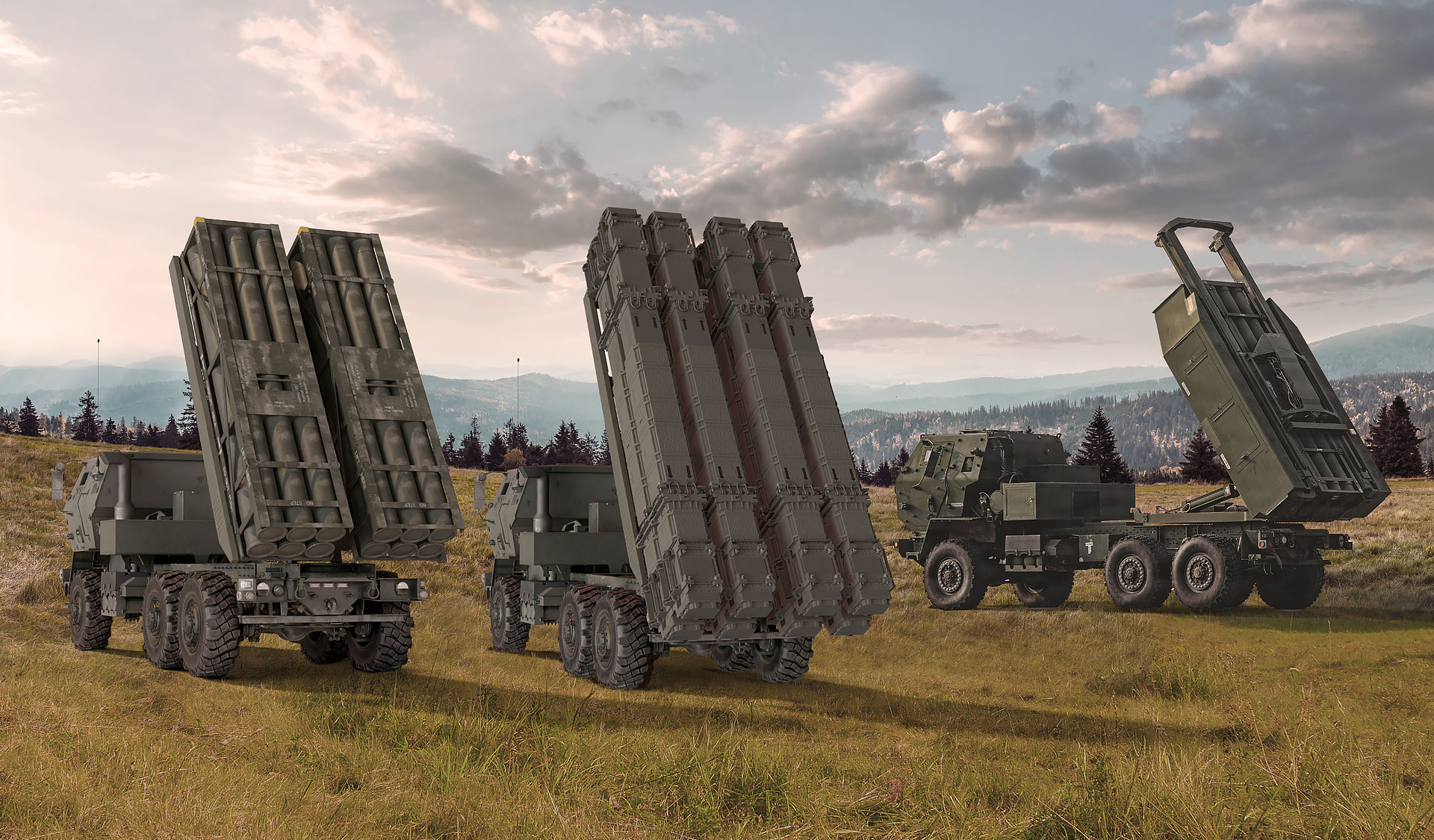
Lockheed Martin has officially unveiled a highly evolutionary variant of its legendary M142 High Mobility Artillery Rocket System, designated as the HIMARS FLEX. This cutting-edge platform integrates the FLEXFires technology ecosystem, an open systems architecture specifically designed to transform tactical and operational mission flexibility across the modern battlespace. Building upon the robust and combat-proven operational heritage of its predecessor, which has accumulated more than 2.5 million operating hours worldwide, this innovation is projected to establish a new benchmark in global precision strike capabilities while significantly reinforcing the inherent conventional deterrence posture delivered to coalition defense forces.
The most significant architectural enhancement of the new system lies in its adoption of dual-pod configurations, a technological leap that effectively doubles the platform’s organic offensive firepower within a single launch asset. Through this structural versatility, the launcher is no longer restricted to conventional surface-to-surface artillery payloads; instead, it can be seamlessly configured simultaneously to deploy tactical air and missile defense interceptors. The platform has been engineered to maintain total compatibility with existing NATO ammunition stockpiles, establishing interoperability across a diverse ordnance profile that includes the Guided Multiple Launch Rocket System (GMLRS), Extended Range GMLRS (ER GMLRS), Precision Strike Missile (PrSM), Army Tactical Missile System (ATACMS), and defensive interceptors such as the Patriot Advanced Capability-3 (PAC-3) and Indirect Fire Protection Capability (IFPC) munitions.
Beyond its raw offensive and defensive lethality, strategic and tactical mobility remains a paramount design priority. The integrated defense asset is built on the established XM1140 chassis, ensuring it retains the exact dimensional constraints required for rapid projection via tactical military transport aircraft, specifically matching the C-130 Hercules envelope. Built-in modularity driven by the FLEXFires suite provides a broad spectrum of adaptation options for both existing partners and new international procurement customers, ranging from a baseline single-pod variant to the expanded dual-pod payload layout, alongside flexible deployment options including mobile vehicle-mounted or containerized static platforms. This modular philosophy drastically reduces initial crew training cycles and lowers long-term sustainment costs while granting allied nations the precise operational latitude needed to adapt the hardware to regional defense doctrines and specific theater requirements.
To effectively counter contemporary near-peer threats characterized by pervasive electronic warfare and counter-battery detection assets, the HIMARS FLEX pairs its expanded payload with highly aggressive shoot-and-scoot survivability, rapid reloading cycles, and advanced autonomous mission execution options. These operational characteristics enable the execution of highly survivable distributed fires across severely contested environments, complicating adversary target acquisition models and degrading their kinetic counter-strike calculations. By integrating natively into joint-fire-control networks, the system transcends the role of traditional field artillery, evolving into a multi-domain deterrence multiplier that bridges offensive precision strikes and forward air defense into a single, cohesive, and battle-proven ecosystem.


