


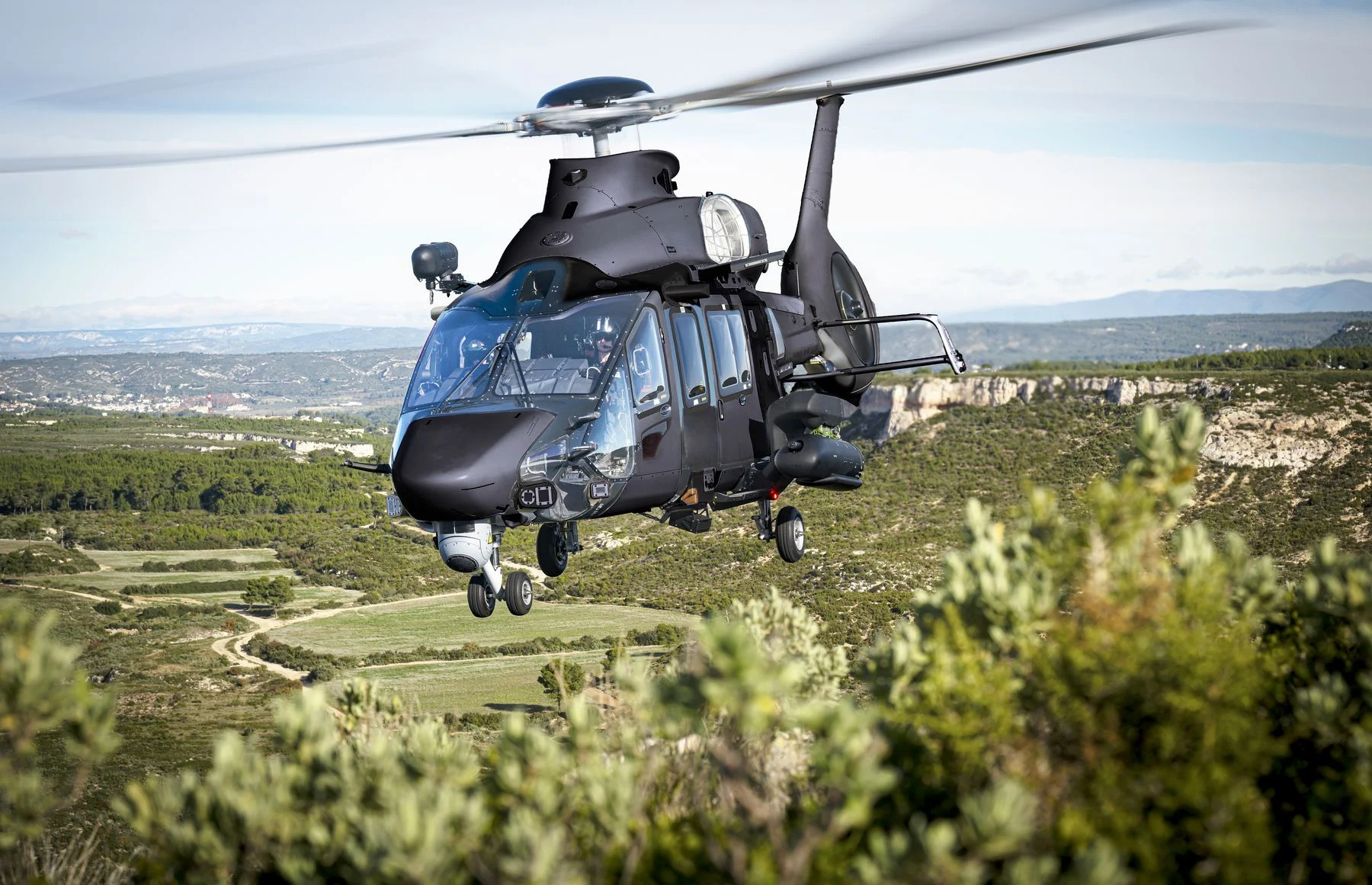
Airbus Helicopters is preparing to conduct a first firing campaign with the H160M equipped with a 12.7 mm axial machine gun. This integration results in automatic target tracking, with the autopilot ultimately responsible for piloting the aircraft’s trajectory in yaw and pitch to guarantee firing accuracy. The H160M will also be equipped with the TopOwl helmet, identical to that of the Tiger, with identical modes and functions, and it will use the same electronic warfare suite as the combat helicopter. The H160M carries a mission assistant for this purpose, developed with Airbus Defence and Space. The aircraft will also be natively equipped with a capability for collaboration with drones. The H160M’s weapon pylons and the associated reinforcements of the structure give it significant growth potential for new developments, such as the integration of new types of air launched effects, missiles, but also remotely operated munitions (drones). The French Defence Procurement Agency (DGA) has green-lit studies on the integration of MBDA’s Akeron LP missile. The Akeron LP is a long-range, lightweight multi-role air-to-ground missile, versatile enough to handle anti-tank missions as well as anti-surface or possibly anti-drone missions. The H160M can be fitted with two internal 250-litre auxiliary tanks, further extending its already impressive range.
“With its large-format touchscreens, the new FlytX avionics installed on the H160M further facilitate mission management. This highly integrated and automated avionics will offer users the possibility of conducting complex missions with a crew of only two people. For the navy, this will involve pilots operating a latest-generation tactical radar equipped with numerous modes, without having to involve a third crew member,” notes Charles Lanzalavi, technical manager of the programme.

“This is a major event for a military aircraft, which features a very high level of integration of its weaponry with its sensors, its avionics, its mission system and even the autopilot. This integration allows us to develop innovative firing modes to maximise the performance of firing passes, not only for the axial machine gun but for other future armaments. The H160M’s weapon pylons must anticipate these needs in terms of physical interfaces. But not all users will necessarily require such a level of performance. By taking advantage of the developments already carried out for the Gendarmerie [French national police] and French Navy, we are already able to offer a version of the H160 today that is perfectly capable of performing a very wide range of military missions. The H160 already delivers an extensive suite of capabilities today; these will only be bolstered in the coming years as the H160M pushes into the highest end of the operational spectrum,” says Vincent Chenot, head of the H160M programme.
The Airbus Helicopters H160 (formerly X4) is a medium utility helicopter developed by Airbus Helicopters. The first of a new generation of helicopters, the H160M is based on the EASA-certified H160. It benefits from cost-optimized maintenance and high safety standards for flight. To ensure a high level of availability while reducing operating costs, the H160M’s support and services needs were taken into account from early in its design phase. Innovative and simplified, the H160M’s support is based on the exploitation of data through analytics. By 2030, at the end of the development and qualification work, all these characteristics will ensure the H160M has power and endurance. The French Navy has been using its aircraft since 2022, and the Gendarmerie received its first aircraft in 2025. These aircraft are notably equipped with a Safran EOS410 electro-optical turret, a searchlight, a hoist and fast ropes, and optional armour. The mission system coupled with specific communication means and data links will enable complex missions. Interoperability with drones constitutes a strong axis of development, with a flight demonstration planned. The integration of cabin-door weaponry is also conceivable. The missions planned for these aircraft include protecting vessels and coastal areas, observation, counterterrorism, and reconnaissance or support for ground forces.


