


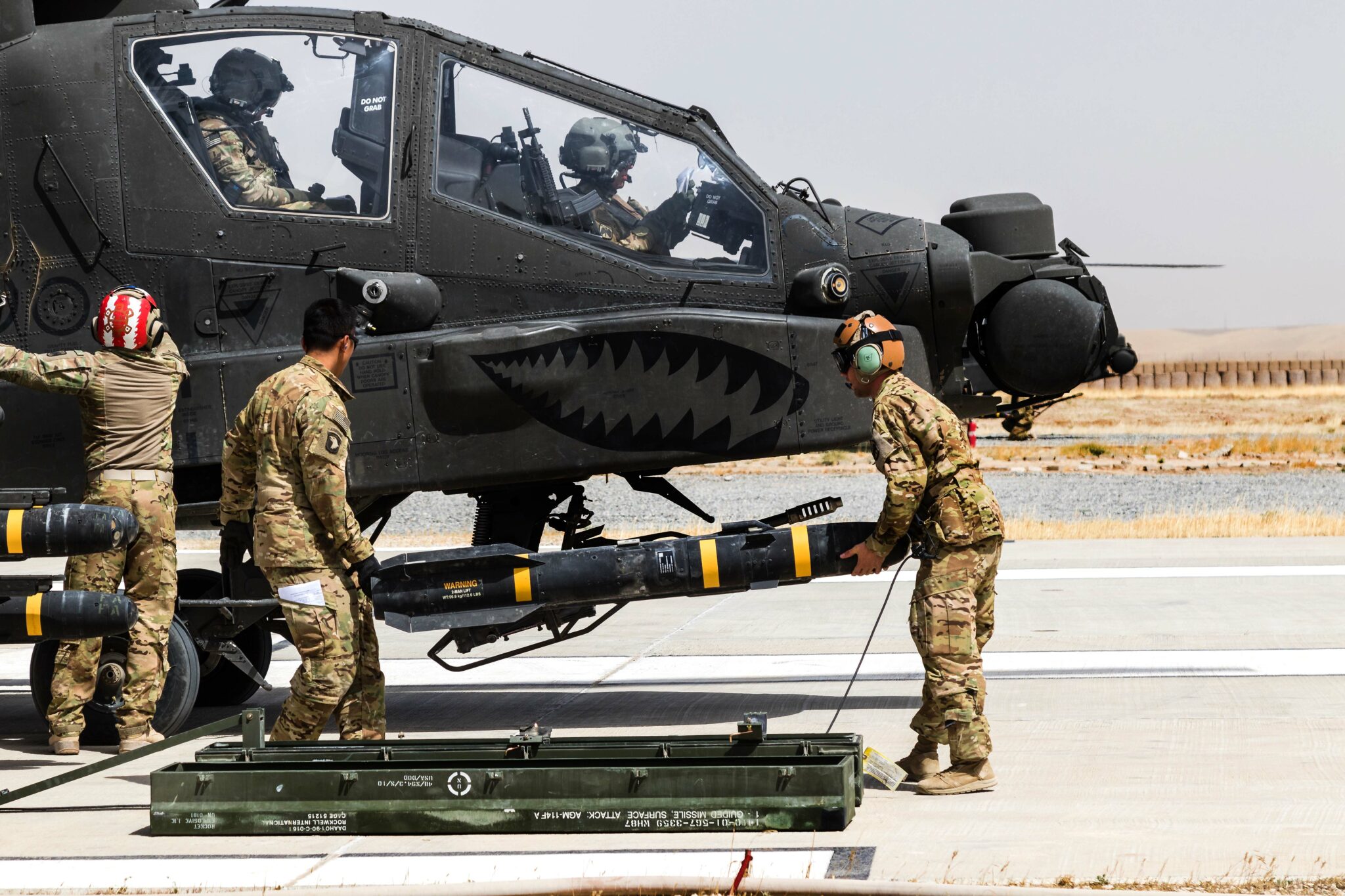
The U.S. Department of State has approved a potential Foreign Military Sales (FMS) package worth up to USD200 million for the Netherlands’ procurement of additional AGM-114R2 Hellfire II air-to-ground missiles, further strengthening the country’s precision-strike capabilities across both manned and unmanned platforms. In a notification released by the U.S. Defense Security Cooperation Agency and approved by the U.S. Department of State, the proposed sale includes up to 530 AGM-114R2 Hellfire II missiles, as well as associated support equipment, technical documentation, engineering services, logistical assistance, and other elements of programme and lifecycle support. The notice stated that the package is intended to improve the Netherlands’ ability to meet current and future threats while enhancing interoperability with United States and allied forces. The estimated value of the government-to-government deal is USD200 million, although the final contract value will depend on the exact quantity of missiles procured, support requirements, and negotiated terms. Under the FMS process, the package must still pass through the required congressional notification and review period before a final Letter of Offer and Acceptance (LOA) can be signed. If the sale is finalised, Lockheed Martin will serve as the prime contractor. The company manufactures the AGM-114 Hellfire family, one of the most widely used precision-guided missile systems in service worldwide.
The AGM-114R2 variant is part of the AGM-114R “Romeo” Hellfire II family, a multi-purpose missile designed to consolidate the capabilities of earlier specialised variants into a single munition. Entering service in 2012, the missile uses semi-active laser homing guidance and is fitted with a K-charge multi-function warhead capable of defeating armoured vehicles, fortified positions, soft targets, and other battlefield threats. The AGM-114R2 has a maximum range of approximately 8 km, weighs around 49 kg, measures about 1.8 m in length, and can travel at speeds of approximately Mach 1.3. Reduced-explosive variants are also available for operations in urban or collateral-sensitive environments. The Hellfire missile was originally developed as the “Heliborne Laser, Fire-and-Forget” missile, from which the acronym-derived nickname “Hellfire” emerged before becoming the weapon’s formal designation. Initially conceived as an anti-armour weapon during the Cold War, the missile has evolved into a multi-mission precision-strike system capable of engaging a broad range of targets. It can be launched from air, land, and maritime platforms, and has been integrated onto systems such as the MQ-1 Predator, MQ-9 Reaper, helicopters, naval craft, and ground-based launchers.
For the Netherlands, the missile serves as the principal air-to-ground precision munition for the Royal Netherlands Air Force’s (RNLAF’s) Apache attack helicopter fleet. The Netherlands ordered 30 Boeing AH-64D Apache helicopters in 1995, with deliveries beginning in 1998 and concluding in 2002. These helicopters significantly expanded Dutch battlefield aviation capabilities and were equipped with the Apache Modular Aircraft Survivability Equipment (AMASE) self-protection suite to improve survivability against infrared-guided missile threats. Dutch Apache helicopters were first operationally deployed in 2001 to Djibouti in support of missions in Africa. They later operated in Bosnia and Herzegovina in support of NATO peacekeeping missions. In 2004, six Dutch Apaches were deployed to Iraq as part of the Netherlands’ contribution to the multinational coalition, where they carried out close air support, reconnaissance, and show-of-force missions. In 2006, six Dutch Apaches were deployed to Afghanistan after the Netherlands expanded its contribution to NATO-led operations there. During these campaigns, Hellfire missiles were used in combat, depleting operational inventories over time.
In addition to its Apache fleet, the Netherlands employs Hellfire missiles on its growing fleet of General Atomics MQ-9A Reaper medium-altitude long-endurance (MALE) remotely piloted aircraft. In November 2013, the Dutch Ministry of Defence selected the MQ-9 Reaper Block 5 to fulfil its MALE UAV requirement. The aircraft are operated by 306 Squadron and are based at Leeuwarden Air Base. In July 2018, the Dutch government signed a Letter of Acceptance under the FMS process for the acquisition of the first batch of MQ-9 systems. The initial procurement included four MQ-9 Block 5 aircraft and four ground control stations, with two based in the Netherlands and two intended for forward deployment. These aircraft were expected to achieve full operational capability in 2023. The Dutch-configured MQ-9A fleet includes specialised sensors such as a Synthetic Aperture Radar (SAR) with maritime search capability, as well as enhanced ground-search radar and electronic surveillance systems capable of detecting radar emissions and signals intelligence targets. The Netherlands has since ordered four additional MQ-9 systems, along with associated guided weapons, including missiles and precision-guided bombs, further expanding the country’s intelligence, surveillance, reconnaissance (ISR), and strike capabilities.


