


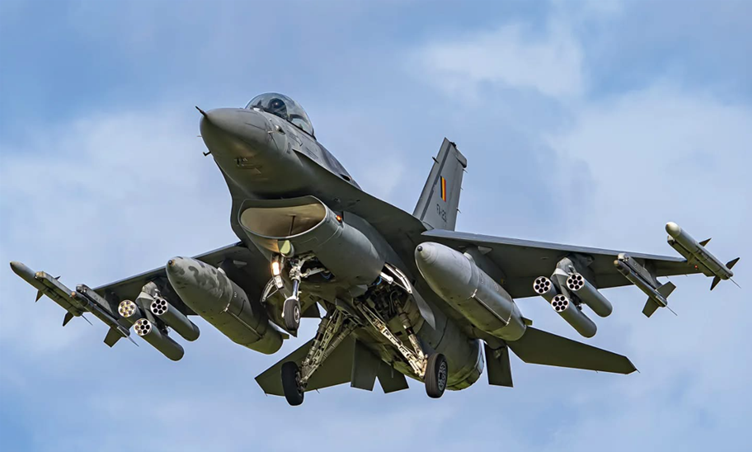
The growing use of inexpensive attack drones in modern conflicts has highlighted a critical challenge for air defence forces: how to counter large numbers of low-cost unmanned systems without relying on disproportionately expensive interceptors. In response, the Belgian Air Component (Air Force) has begun evaluating laser-guided 70 mm rockets as a cost-effective means of neutralising such threats. Officials from Belgium Defence noted that recent conflicts have demonstrated the destructive potential of relatively cheap unmanned aerial vehicles (UAVs). Employing conventional air-defence missiles against these platforms can be operationally effective but financially inefficient, prompting efforts to develop lower-cost engagement options capable of maintaining sustainable counter-UAS operations. To address this evolving threat environment, the Belgian Air Component has initiated test campaigns involving guided 70 mm rockets designed for precision engagement of small aerial targets. Among the systems under evaluation is the FZ275 LGR developed by Thales Belgium, alongside the U.S.-developed AGR‑20F Advanced Precision Kill Weapon System.
Testing of the FZ275 LGR began earlier in 2026 and is intended to support potential integration of the weapon on Belgium’s F‑16 Fighting Falcon fleet. The initiative aims to provide the aircraft with an affordable precision-strike option capable of intercepting drones and other light targets while reducing reliance on more expensive air-to-air or surface-to-air missiles. The FZ275 LGR is a semi-active laser-guided rocket originally developed by Forges de Zeebrugge, now part of Thales Group. Designed to convert standard unguided 70 mm rockets into precision-guided munitions, the system provides an economical alternative to traditional guided missiles while maintaining compatibility with existing rocket launch platforms. The weapon measures approximately 1.8 m in length and has a launch mass of around 12.7 kg. It carries a 4.1 kg high-explosive fragmentation warhead filled with Composition B and fitted with an impact fuze. Powered by the FZ276 MOD.1 rocket motor, the FZ275 LGR has an operational range of between 1.5 km and 7 km and can achieve a circular error probable (CEP) of roughly 1 m at a range of 6 km under optimal conditions.

Guidance is provided through a semi-active laser seeker, allowing the rocket to home in on laser energy reflected from the designated target. The system supports both lock-on-before-launch and lock-on-after-launch engagement modes and can receive laser designation from the launch platform or from a remote source such as another aircraft or ground unit, increasing tactical flexibility and survivability. Although originally designed for launch from attack helicopters, the FZ275 LGR can be integrated onto multiple platforms, including fixed-wing aircraft, unmanned aerial vehicles, land vehicles, and naval platforms. Its compatibility with existing 70 mm rocket launchers allows for relatively straightforward integration and minimal additional training requirements for operators. Production of the system is ramping up as demand for counter-drone capabilities increases. Output is projected to reach approximately 700 rockets in 2024 and 3,500 units in 2025, with plans to expand production to around 10,000 units annually by 2026. In November 2024, Thales Belgium also signed an agreement with a Ukrainian partner company to produce the FZ275 LGR in Ukraine for operational use against drone threats.
Belgian defence officials say the ongoing evaluation reflects broader efforts to adapt to the rapidly evolving drone threat environment. By integrating relatively low-cost precision-guided rockets into existing platforms, Belgium aims to field a scalable and economically sustainable capability to counter attack drones in future conflicts. The FZ275 LGR – Laser Guided Rocket is a weapon system designed by Forges de Zeebrugge. Forges de Zeebrugge is an arms manufacturer in based in Herstal, Belgium. During World War II, the site was taken over by German forces. Allied bombing, especially in July 1943, devastated the factory site; the original munitions factory was never rebuilt and later remediation of this site was difficult due to unexploded munitions. The surviving FZ business changed focus to rocketry, since 2017 owned by Thales Belgium. As of December 31, 2016, Forges de Zeebrugge S.A. has changed its company name to Thales Belgium S.A. whilst keeping its protected brand names ‘FZ’ and ‘Forges de Zeebrugge’ for its commercial communication.


