


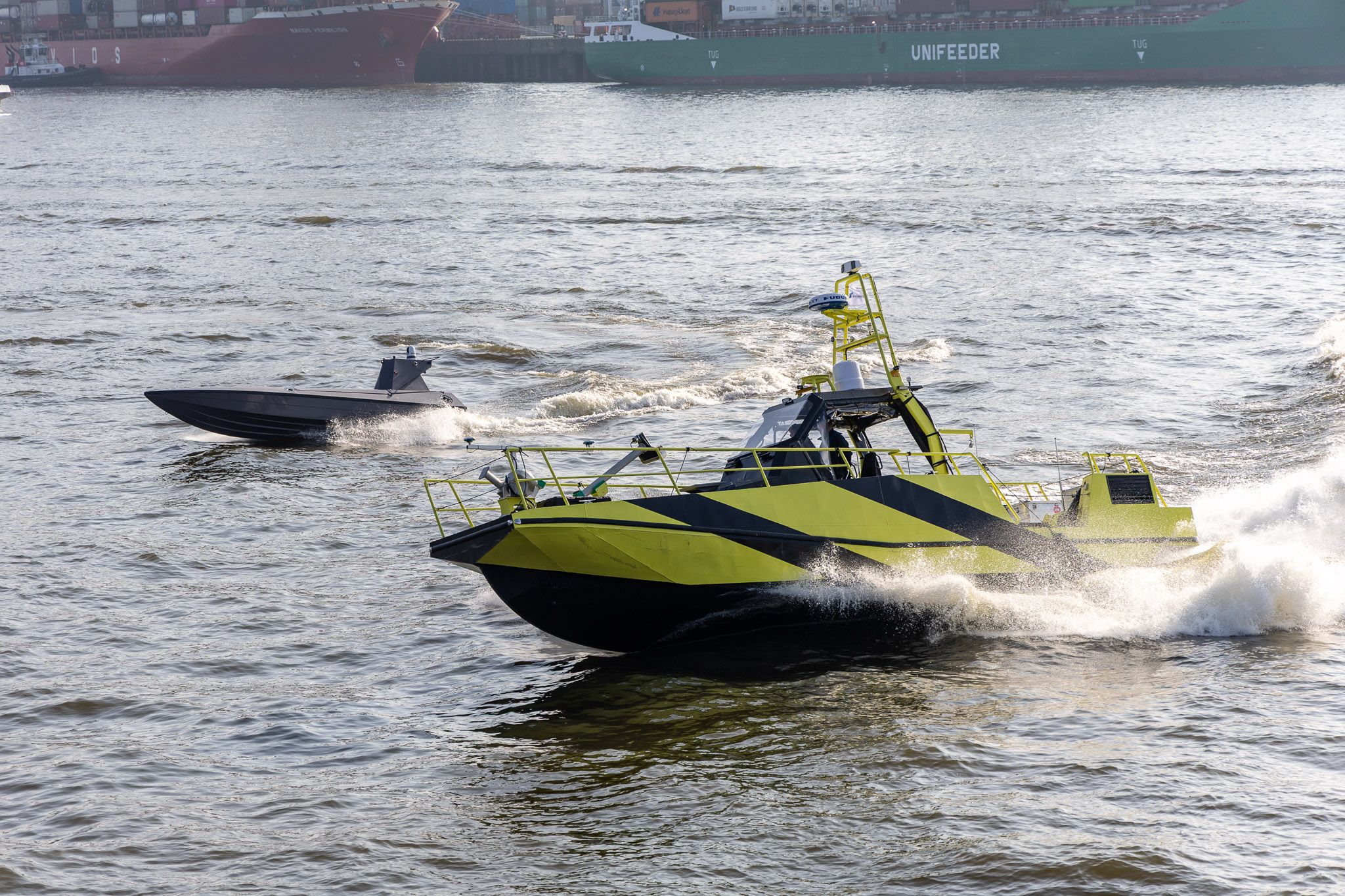
German shipbuilder Blohm+Voss has presented two unmanned surface platforms during a media demonstration at its Hamburg shipyard, highlighting the company’s expanding role in autonomous maritime technologies. The event featured the autonomous test vehicle AMC12 (Autonomous Modular Craft) and the Kraken Scout Medium unmanned surface vessel (USV), both aimed at supporting future naval and security operations involving a mix of crewed and uncrewed platforms. The demonstration was attended by several senior German maritime and defence officials, including Christoph Ploß, the Federal Government’s Maritime Coordinator, Reinhard Lüken, chief executive officer of the German Shipbuilding and Marine Technology Association, and Tim Wagner, head of the Naval Systems division at Rheinmetall. The presentation underlined Germany’s growing interest in integrating autonomous maritime systems into future fleet structures.
At the centre of the demonstration was the AMC12, described by Blohm+Voss as a technology-open platform designed to support the development and testing of autonomous maritime capabilities. The craft is intended to contribute to concepts for future hybrid fleets in which manned ships operate alongside unmanned surface vehicles and other autonomous systems. The AMC12 platform is scheduled to undergo its first operational testing in real maritime conditions during the SeaSEC 2026 maritime security exercise in April. During the exercise, the system will support experimentation with autonomous operations and modular mission payloads. Following the trials, the vessel will be employed in a joint development programme with the Hamburg Port Authority aimed at creating a mission module designed to enhance the protection of port infrastructure. Such systems could be used for surveillance, patrol, and rapid response missions in sensitive harbour environments.
Alongside the AMC12 prototype, Blohm+Voss also showcased the Kraken Scout Medium, a commercially available USV developed in partnership with the Kraken Technology Group through a UK–German joint venture. The platform is intended for both military and civilian maritime applications, including security, patrol, and infrastructure monitoring roles. According to the company, the high-speed USV is capable of reaching speeds of up to 55 knots, offering rapid deployment capabilities for missions requiring fast response in coastal and port environments. The vessels are produced at Rheinmetall’s shipbuilding facilities in Hamburg. The unveiling of the two platforms reflects a broader trend among European naval industries and governments toward expanding the role of autonomous maritime systems. Such technologies are increasingly viewed as force multipliers that can extend surveillance coverage, reduce risk to personnel, and support distributed maritime operations in both defence and security contexts.


