


Since the fall of the Berlin Wall, the number of countries possessing submarines has surged, with some 45 countries now operating them. What was once a strategic asset reserved for powerful navies is now accessible to a diverse range of military forces. Today, many countries operate at least two submarines, utilizing them for both intelligence-gathering and combat missions. This increase poses a significant strategic challenge for Anti-Submarine Warfare (ASW). The challenge is further exacerbated as submarines become increasingly stealthier, making them more difficult to detect and counter. NATO forces and other navies face two significant challenges: First, they must overcome the inherent limitations of Hull-Mounted Sonar (HMS), where the variability of sound propagation often leaves critical detection gaps, especially in complex underwater environments. Second, they need to match their ASW capabilities to the demands of resurgent, high-intensity conflicts in Europe, particularly in the North Atlantic and Mediterranean theatres. Navies are taking decisive action to respond to this renewed threat. While they recognise that Hull-Mounted Sonar (HMS) still plays a valuable role in anti-submarine warfare (ASW), many are actively turning to Variable-Depth Sonar (VDS) as a solution that can offer superior performance amidst increasing conflicts.
With extensive experience serving a diverse global customer base, including many leading navies, Thales can tailor solutions to meet specific needs. Combining decades of experience in developing sonar solutions across various platforms with a strong commitment to major R&D and significant investment in digital technology, Thales is well equipped to deliver the technological superiority that provides navies with an edge in countering hostile submarines. This expertise and technical superiority are embodied in the CAPTAS-2 sonar. Larger and more powerful than the CAPTAS-1, CAPTAS-2 strikes a carefully balanced combination between compactness, cost-effectiveness and performance, specifically designed for medium-sized frigates. Launched in the late 1990s, the CAPTAS-2 is now operational across eight different platform types and with a wide range of customer navies – including those of Egypt, Saudi Arabia, Malaysia, Mexico, Norway, Poland, and the United Arab Emirates. With over 25 years of operational success, the system has become an industry benchmark.
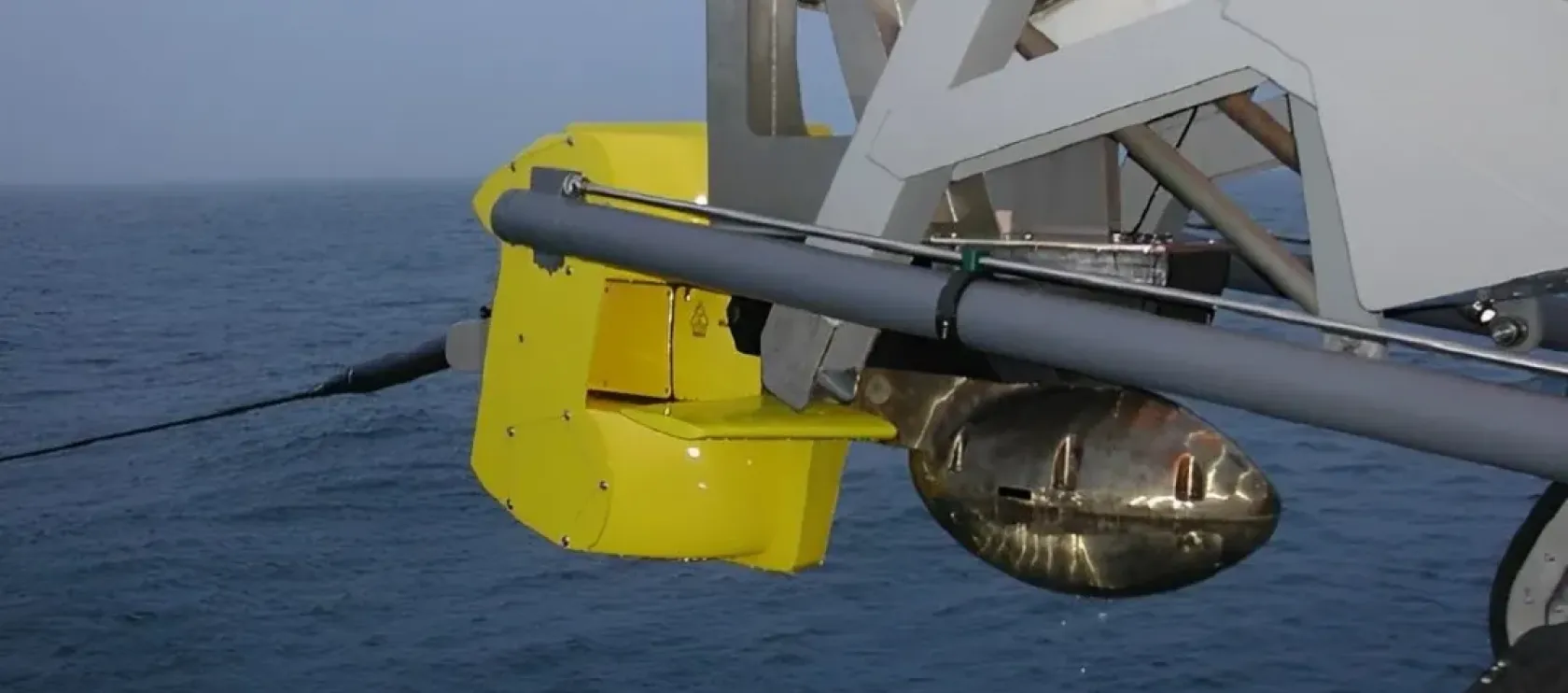
(Combined Active Passive Towed Array Sonar 2) CAPTAS-2 is the best compromise of compactness and performance for medium-sized frigates and is on board many ships around the world. (Photo by Thales)Capable of detecting targets up to a distance of approximately 60 km (1st Atlantic Convergence Zone), CAPTAS-2 offers high-performance Variable-Depth Sonar (VDS) against stealth submarines, ensuring force protection and anti-access/area-denial (A2AD) missions. It provides long-range, simultaneous active and passive 360° surveillance and analysis, along with a permanent all-round torpedo alert. The system enhances detection in shallow waters, and performs equally well in deep water, thanks to its high source level, low frequency and long pulses. Additionally, it is well equipped to reduce reverberation effects due to limited vertical directivity and wide bandwidth. Thales’s strong commitment to innovation has led to significant advancements in CAPTAS-2 since its initial deployment at sea – ensuring it remains technically superior and easier to operate. The system now features an enhanced, operator-centric design that utilizes intuitive human-machine interfaces (HMI) to streamline operations, reduce operator workload and increase mission efficiency. Additionally, it leverages the power of Artificial Intelligence (AI) and big data analysis for advanced signal processing and threat identification. CAPTAS-2 also offers enhanced connectivity for seamless integration into naval Combat Management Systems (CMS) and robust cybersecurity measures to safeguard sensitive operational data.
Furthermore, CAPTAS-2 is designed to work seamlessly with other Thales sonar. In multistatic configurations, it is fully interoperable with the entire Thales sonar portfolio, including the CAPTAS Variable Depth Sonar family, the Hull Mounted Sonar family, FLASH dipping sonar and the SonoFlash sonobuoys. Together, these systems can create an optimal sonar suite, providing significant flexibility for multipurpose frigates engaged in Anti-Submarine Warfare (ASW). In summary, CAPTAS-2 is a meticulously tailored solution for medium-sized frigates, offering the capability to operate independently or in conjunction with other sonar systems. It is designed to deliver an optimal balance of acoustic performance, size and cost-effectiveness. Thales’s strong commitments to user-centric design, continuous innovation, and incorporating feedback from customers worldwide – ensures that CAPTAS-2 remains a powerful solution, especially at a time when Anti-Submarine Warfare (ASW) is more crucial than ever.


