


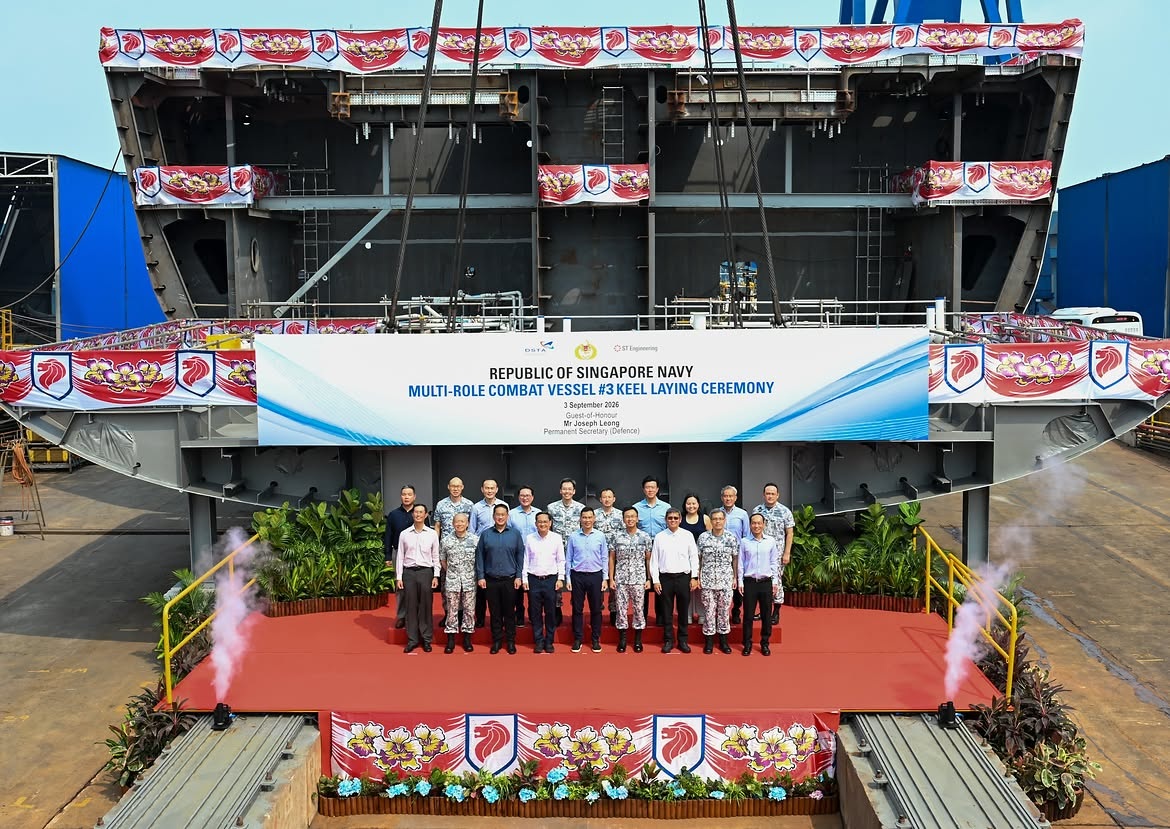
The Republic of Singapore Navy (RSN) is advancing the development of its new Victory-class Multi-Role Combat Vessel (MRCV), a fleet of six platforms engineered to succeed the service’s legacy Victory-class missile corvettes. First revealed in 2018, the program is led by Singapore’s Defence Science and Technology Agency (DSTA), DSO National Laboratories, and ST Engineering, in collaboration with European defense prime contractors Saab Kockums and Odense Maritime Technology. Formulated by the Ministry of Defence (MINDEF) to function simultaneously as high-end combat frigates and command “motherships” for autonomous systems, the MRCVs will rank among the largest surface combatants operated by the RSN upon their phased commissioning between 2028 and 2030. The platforms are designed to project power and extend operational reach across the surface, subsurface, and aerial domains through the seamless deployment and recovery of Unmanned Surface Vessels (USVs) such as the Venus 16, Autonomous Underwater Vehicles (AUVs), and Unmanned Aerial Vehicles (UAVs).
Operational versatility remains a core design philosophy of the class, featuring a dedicated mission bay capable of housing eight modular containers tailored to specific mission profiles, including high-intensity surface warfare and Humanitarian Assistance and Disaster Relief (HADR) operations. Tactical mobility and organic craft operations are facilitated by two specialized launch and recovery systems (LARS) installed on the port side and stern, while onboard embedded simulators minimize reliance on shore-based facilities to support operational readiness and synthetic training. Propulsion and service electric power are supplied by a 30 MW Integrated Full Electric Propulsion (IFEP) system delivered by GE Vernova, which energizes both ship propulsion and high-demand combat payloads. In a deliberate logistics decision, DSTA selected an all-diesel prime mover setup rather than incorporating gas turbines, intentionally trading off higher top-speed sprint capability and acceleration to maintain commonality with the RSN’s diesel-only logistics, maintenance, and training infrastructure—a decision judged fully mitigated by the force-multiplying effects of embarked autonomous platforms.

The sensor and suite baseline reflects a modern, multi-domain warfighting architecture centered around an integrated mast housing four active electronically scanned array (AESA) radar panels, featuring the Thales Sea Fire multifunction radar alongside Safran electro-optical/infrared (EO/IR) surveillance sensors. Fire control and anti-air warfare capabilities rely on a diverse missile complement, combining the MBDA VL MICA NG short-to-medium range and Aster 30 Block 1 NT long-range surface-to-air missiles—marking the first time both air-defense effectors will be integrated onto a single RSN surface platform. For anti-ship strike operations, reports indicate the selection of the Blue Spear surface-to-surface missile jointly developed by ST Engineering and Israel Aerospace Industries, delivering long-range standoff precision strike capability against heavily defended naval targets.
Complementing its missile loadout, the MRCV’s organic gun armament incorporates Leonardo’s STRALES 76 mm guided gun system as its primary surface-to-air and surface-to-surface naval artillery, supplemented by Rafael’s Typhoon Mk-30c 30 mm remotely controlled weapon station (RCWS) for close-in defense against asymmetric surface threats and low-altitude aerial targets. Sub-surface warfare assets under consideration for the vessel’s acoustic sensor and torpedo suite include EuroTorp’s MU90 Impact lightweight torpedo and Leonardo’s A244/S lightweight torpedo, providing multi-layered defense in complex littoral and blue-water environments. Together with its extensive modularity and unmanned command architecture, the Victory-class MRCV represents a cornerstone in the RSN’s broader transformation into a modern, networked, and technologically superior maritime force.


