


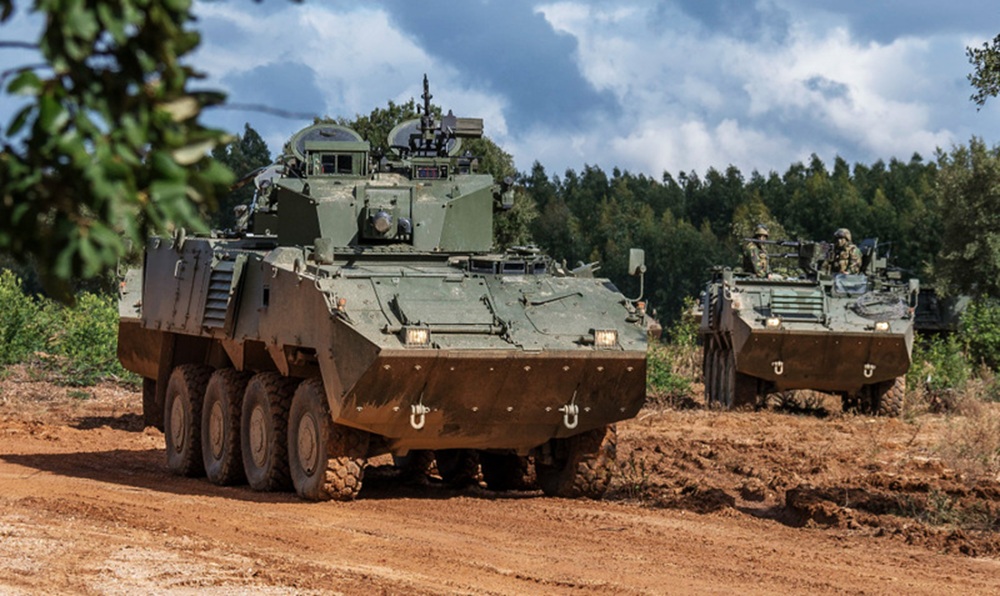
The Portuguese Ministry of National Defense initiated a major modernization effort for its ground forces in 2005 by awarding a EUR364 million (USD396 million) contract for 260 Pandur II 8×8 wheeled armored vehicles, alongside an associated EUR516 million offset package. Intended to equip the Portuguese Army’s Intervention Brigade and the Portuguese Navy’s Marine Corps, Lisbon became the launch export customer for the platform. Under the industrial arrangement, Austrian manufacturer Steyr-Daimler-Puch Spezialfahrzeuge—a subsidiary of General Dynamics European Land Systems (GDELS)—produced the initial batch of 41 units before transferring domestic assembly of the remaining 219 hulls to local prime contractor Fabrequipa. However, delivery delays prompted the defense ministry to unilaterally terminate the contract in October 2012 after receiving only 166 platforms. Following subsequent renegotiations, a revised agreement was finalized in September 2014 to deliver an additional 22 vehicles by August 2015, effectively capping total procurement at 188 units and canceling planned specialist variants including mortar carriers, engineering vehicles, and all 20 amphibious hulls intended for the marines.
The operational fleet delivered to the Portuguese Armed Forces comprises a diverse range of configurations tailored to specific mission profiles. The army variant features Steyr add-on armor packages providing ballistic protection up to STANAG 4569 Level 4 standards, whereas the marine variants were integrated with Level 3 protection and rear cargo ramps in lieu of twin swing doors. Frontline inventory breakdown includes 105 standard Infantry Carrier Vehicles (ICVs) mounting 12.7 mm heavy machine guns, seven ICVs outfitted with Kongsberg Protector M151 Remote Weapon Stations (RWS), 16 command post variants, 30 Infantry Fighting Vehicles (IFVs) equipped with SP30 turrets armed with 30 mm automatic cannon, and five anti-tank variants firing TOW missiles via the Improved Target Acquisition System (ITAS). The remaining inventory encompasses seven recovery vehicles, eight medical evacuation platforms, six signals nodes, and four battlefield surveillance assets. Notably, an option for 33 Mobile Gun Systems (MGS) housing 105 mm high-pressure guns was never exercised, despite localized mobility and firepower trials conducted at the Santa Margarida Military Camp utilizing Leonardo HITFACT 105 and CMI Defence CT-CV 105 HP turrets.
Developed as an internal commercial venture by Steyr-Daimler-Puch, the Pandur II 8×8 represents an upgraded, extended-hull evolution of the proven Pandur 6×6 Armored Personnel Carrier (APC) design. The baseline platform utilizes an all-welded steel monocoque hull engineered to accept modular passive add-on armor packages, defending against small arms armor-piercing rounds ranging from 7.62 mm to 14.5 mm calibers depending on customer specification. Designed for tactical airlift, the vehicle’s external envelope allows roll-on/roll-off transportation inside C-130 Hercules transport aircraft. The hull layout positions the driver at the front-left, equipped with a single-piece hatch and three day periscopes—with the central optic convertible to a passive thermal/night vision device—while the powerpack is housed in an isolated compartment to the front-right. Mobility across varying terrain is governed by an upgraded heavy-duty suspension system and a two-stage synchronized transfer gearbox facilitating swift transitions between highway and cross-country drive modes.
In terms of interior payload and modular architecture, the Pandur II accommodates various heavy weapon stations and troop seating configurations based on operational requirements. When integrated with complex two-man weapon stations such as the SP30 turret—which is also fielded on the Austrian-Spanish ASCOD armored fighting vehicle—the troop compartment accommodates up to six fully equipped infantry dismounts. In a baseline APC role featuring externally mounted or light remote weapon stations, the interior volumetric layout expands to carry up to 12 military personnel. While primary manufacturing originated at Steyr’s facility in Austria, global production and assembly pipelines for the 8×8 platform were established under license across European partner facilities, including Excalibur Army in the Czech Republic and Fabrequipa’s manufacturing plant in Barreiro, Portugal.


