


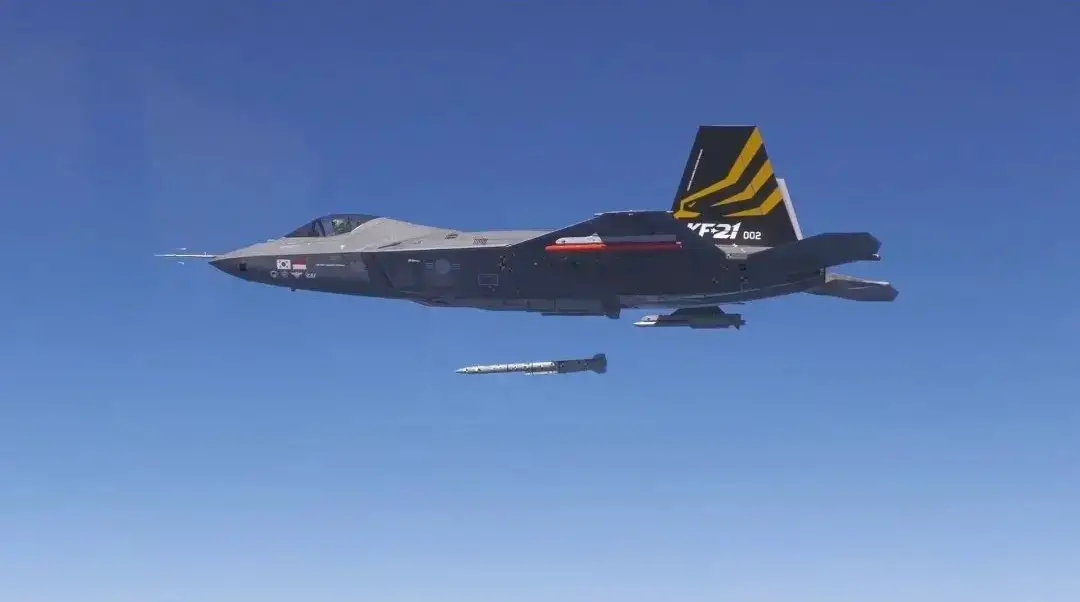
Hanwha Aerospace and Korea Aerospace Industries (KAI) have signed a memorandum of understanding (MOU) to deepen their collaboration on the integration of a domestically developed long-range air-to-air missile onto South Korea’s KF-21 Boramae multirole fighter. Announced on 23 September, the agreement outlines joint efforts to bolster the development of indigenous air-launched munitions and ensure the seamless operational deployment of the aircraft. This strategic partnership builds upon earlier agreements signed in February during events in Seoul and at the World Defense Show in Riyadh, Saudi Arabia, where both defense contractors committed to joint international marketing and supply chain integration to enhance South Korea’s footprint in the global defense market.
The collaboration leverages Hanwha’s extensive footprint across the KF-21 platform, which completed primary system development in June. Hanwha Aerospace manufactures the aircraft’s engines, landing gear, and flight control systems, while Hanwha Systems produces critical mission architecture including the active electronically scanned array (AESA) radar, electro-optical targeting pods (EO-TGP), infrared search and track (IRST) sensors, and the main mission computer. By aligning aircraft manufacturing with avionics and weapons integration, the two companies aim to streamline software architecture and mechanical fitment, ensuring full operational synergy between the airframe and its indigenous weapons suite.

To support the missile integration effort, Hanwha Aerospace is advancing technical capabilities under a government-led program focused on interoperability design technology for aircraft-launched air-to-air missiles, targeting completion by the first half of 2025. In parallel, the company has been maturing propulsion technologies, having completed five of six defense development tasks related to solid ducted ramjet (SDR) engines since 2021. These research initiatives encompass key technologies for both supersonic air-to-air missiles and high-speed target drones, providing the foundational propulsion performance required for extended-range interceptors.
Leveraging over four decades of solid-propellant expertise and more than 20 years in ramjet propulsion research, Hanwha Aerospace remains South Korea’s sole defense firm capable of managing the complete lifecycle of solid-propellant guided weapons, from chemical raw material synthesis to component manufacturing. Company officials emphasized that localizing the long-range air-to-air missile capability is crucial to maximizing the combat effectiveness and export competitiveness of South Korea’s indigenous fighter fleet, mitigating dependency on foreign weapons systems while bolstering domestic supply chain resilience.


