


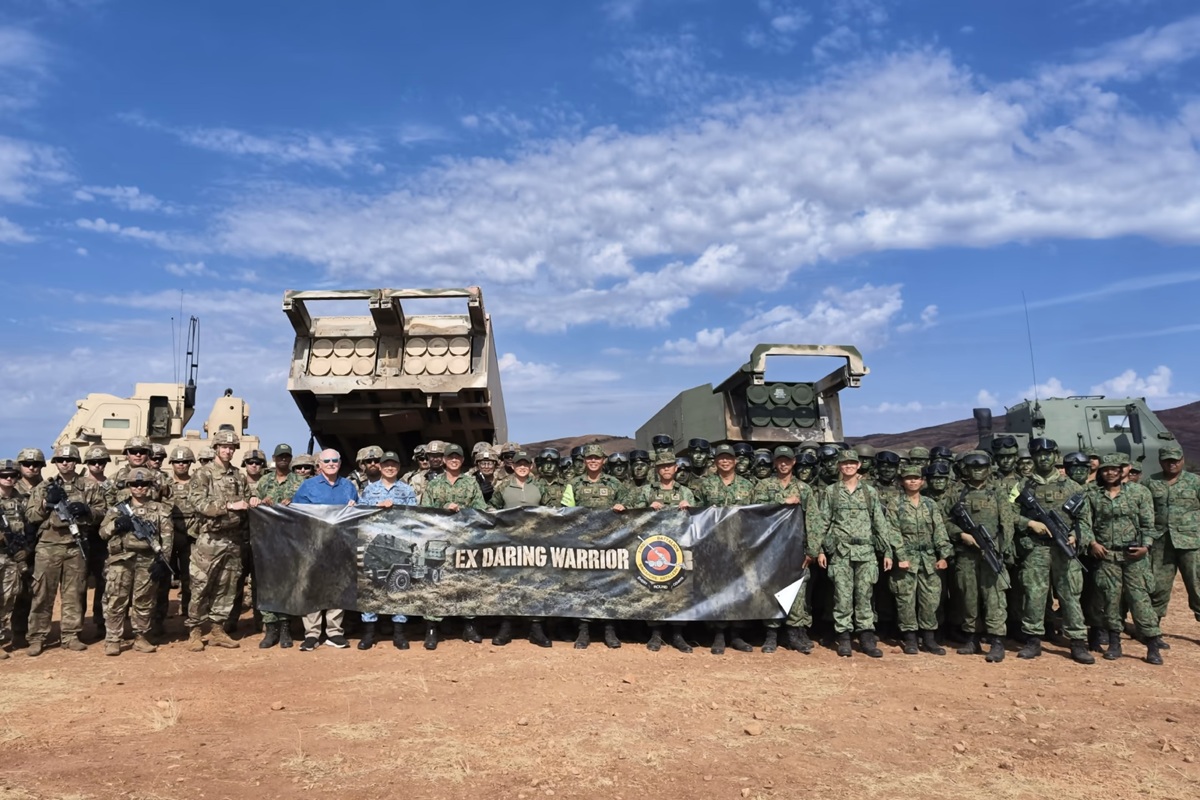
Singapore’s Minister of State for Defence Desmond Choo visited Fort Sill, Oklahoma, to witness a bilateral live-firing iteration of Exercise ‘Daring Warrior’ alongside US Army forces, the Singapore Ministry of Defence (MINDEF) announced on 23 September. Running from 29 August to 28 September 2026, the bilateral training event brought together roughly 110 Singapore Armed Forces (SAF) personnel and 50 US Army personnel for joint artillery maneuvers aimed at enhancing interoperability and long-range precision strike capabilities.

The exercise highlighted high-volume surface-to-surface fires capabilities, featuring High Mobility Artillery Rocket Systems (HIMARS) operated by the Singapore Army’s 23rd Battalion, Singapore Artillery, operating in tandem with M270 Multiple Launch Rocket Systems (MLRS) from the US Army’s 75th Field Artillery Brigade. During his visit, Choo received operational updates, observed joint strike missions utilizing the Day Night Ranging System (DNRS), and participated in a firing sequence following a safety orientation.

Speaking following the capability demonstration, Choo emphasized the strategic value of conducting large-scale maneuvers outside Singapore’s geographically constrained territory. “Exercise Daring Warrior is an extremely important exercise for the SAF,” Choo remarked, noting that the vast training area allows Singaporean units to hone operational skills alongside US counterparts. He also referenced Singapore’s upcoming 60 years of National Service (NS60) commemorations in 2027, underscoring the vital role conscript and regular servicemen play in maintaining the island nation’s overall deterrence posture.

First established in 2010, the 2026 iteration marks the 11th edition of Exercise Daring Warrior, illustrating the enduring defense partnership between the US and Singapore. Designed to fulfill the SAF’s High Mobility Artillery Rocket System (HIMARS) live-firing and training evaluation requirements while overcoming Singapore’s land constraints. The recurring exercise series serves as a critical vector for doctrine alignment, combined tactical fire direction, and complex operational training that cannot be replicated within Singapore’s domestic airspace and range bounds.


