


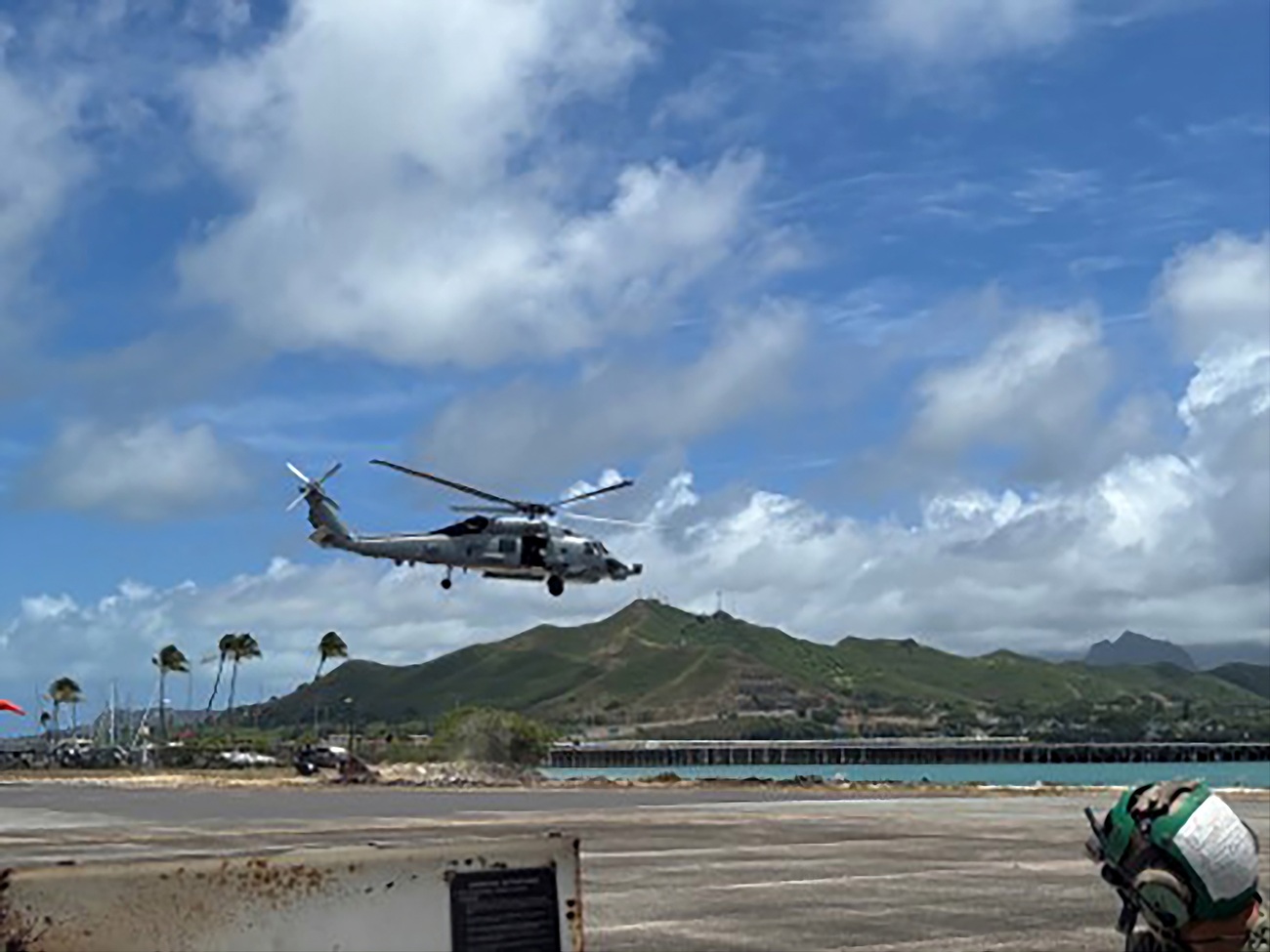
This summer at RIMPAC 26, Lockheed Martin collaborated with the U.S. Navy to successfully demonstrate a rapidly retrainable AI/ML sonar expert for antisubmarine warfare (ASW). The system, known as SensorMAX™, monitors spectral energy including subsurface acoustic data to assist the crew with rapid threat detection. Augmented by over-the-air (OTA) model update capability, SensorMAX aims to dramatically improve the U.S. Navy’s subsurface detection capabilities. SensorMAX uses AI/ML technology to understand ocean sounds. Taking in subsurface acoustic data from a network of sensors, SensorMAX provides a continuous data stream to the aircrew and sends information to the ground station. When a new target is identified, system operators label the identified noise signature, retrain the model on the new data and push a small update packet back to the aircrew. This closed-loop workflow – capture, label, retrain and deploy – enables the crew with continuously enhanced situational awareness throughout their mission. Retraining the model takes under 5 minutes per iteration. The success of the exercise proves that an integrated force of MH-60R helicopters and AI-enabled acoustic experts can detect and track underwater threats faster and more effectively than traditional methods, accelerating the Navy’s vision for fleetwide adoption of crew-uncrewed teaming. By demonstrating platform-agnostic AI intelligence and classification, the future fleet can leverage any acoustic sensor to expand the protective ring around high-value assets and accelerating the ASW kill chain.
Off the coast of Hawaii during RIMPAC, two MH-60R helicopters equipped with Lockheed Martin’s AI/ML system conducted a series of ASW missions against an undersea threat:
- MH-60R helicopters deploy sonobuoys as underwater microphones, listening to the subsurface environment and feeding acoustic data to SensorMAX
- SensorMAX serves as the Navy’s AI portable sonar expert, persistently monitoring data from the sonobuoys and assisting the crew with target identification. The system interface enables aircrew to manage up to eight simultaneous sonobuoy surveillance feeds, doubling the capacity of legacy capabilities.
- Ground operators retrained SensorMAX’s models on new sounds in minutes, then transmitted AI-enhanced undersea intelligence OTA using an encrypted data link directly back to the helicopter and the fleet.
Core Capabilities
- Cross-sensor AI training. Lockheed Martin’s SensorMAX can process data from a variety of sensors supporting operations with commercial and defense applications.
- Works everywhere. Because SensorMAX is lightweight and portable, the same “brain” could be used for data processing in the air, at sea or on land.
- Rapid inflight classifier update. The ability to update the AI classifier during flight shortens detection-to-engagement time when new threats are detected, giving the helicopter crew a decisive edge against enemy submarines.
- Model updates OTA. Model updates are delivered over-the-air. Lockheed Martin’s collaboration with FUSE Inc. enables secure, resilient software delivery to deployed aircraft, allowing SensorMAX’s trained AI models and mission software to be updated rapidly without interrupting operations.
The Lockheed Martin Corporation is an American defense and aerospace manufacturer. It is headquartered in North Bethesda, Maryland, United States. The company was formed by the merger of the Lockheed Corporation with Martin Marietta on March 15, 1995. Lockheed Martin operates 4 divisions: Lockheed Martin Aeronautics; Lockheed Martin Missiles and Fire Control; Lockheed Martin Rotary and Mission Systems; and Lockheed Martin Space. The company also invests in healthcare systems, renewable energy systems, intelligent energy distribution, and compact nuclear fusion.


