


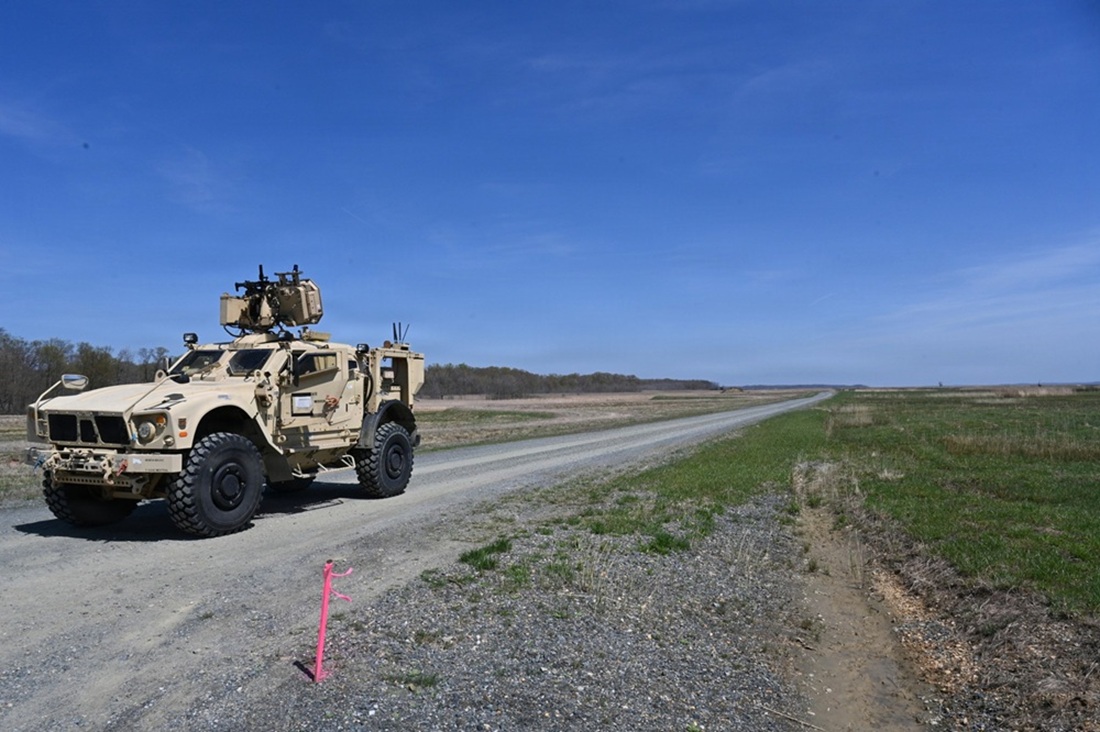
A new effort led by the U.S. Army Combat Capabilities Development Command Armaments Center demonstrated advancements developed for fire control, enabling the ability to engage and defeat drones with a common remotely operated weapon station while shooting on the move. The fire control project is a Science and Technology Integration Office software effort that is designing, developing and demonstrating advanced counter-drone fire control capabilities. The project underwent testing in April at the Aberdeen Proving Ground in Aberdeen, Maryland. According to Nick Cascia, project officer, the initiative began as a mission-driven response to the emerging small unmanned aerial system threat after leadership directed the team to pursue an advanced fire control capability to defeat small drones.

The effort integrated the Armaments Center’s Gunslinger fire control, originally developed under the Future Attack Reconnaissance Aircraft program, and adapted it for ground-to-air targeting. The remote weapon station is able to defeat small moving targets while the vehicle is in motion by using the Gunslinger’s fire control, as well as various vehicle sensor feeds, to provide real-time data, ensuring the weapon is accurately aimed at the target drone. This fire control solution uses a modular open system approach, so the developed software as well as any future enhancements can be shared across the Army. Once matured, the software will improve system accuracy against drones, reducing the number of rounds needed to defeat the threat.

According to James Little, deputy project lead, the development team received promising results from their April tests and will iterate and build upon these results in subsequent tests to improve system performance. With these tests, developers will continue to increase the speed of both the vehicle and drone. “It’s a great start to the effort,” Cascia explained. “The [project] team has put considerable time and effort into developing our advanced fire control algorithms and preparing for this test. Once we started destroying drones, it showed the hard work was paying off.”

The U.S. Army DEVCOM Armaments Center (DEVCOM AC), sometimes the Armaments Center (AC), is the United States Army’s primary research and development facility for armaments and munitions. DEVCOM AC is headquartered at the Picatinny Arsenal in New Jersey. In February 2019, the Armament Research, Development and Engineering Center (ARDEC) became the CCDC Armaments Center, when it was aligned with U.S. Army Futures Command – along with its senior organization, the U.S. Army Combat Capabilities Development Command. The DEVCOM Armaments Center performs research for the U.S. Army, the U.S. Special Operations Command (SOCOM), and other U.S. military organizations.[2] It is one of several specialized research centers in the U.S. Army Transformation and Training Command.


