


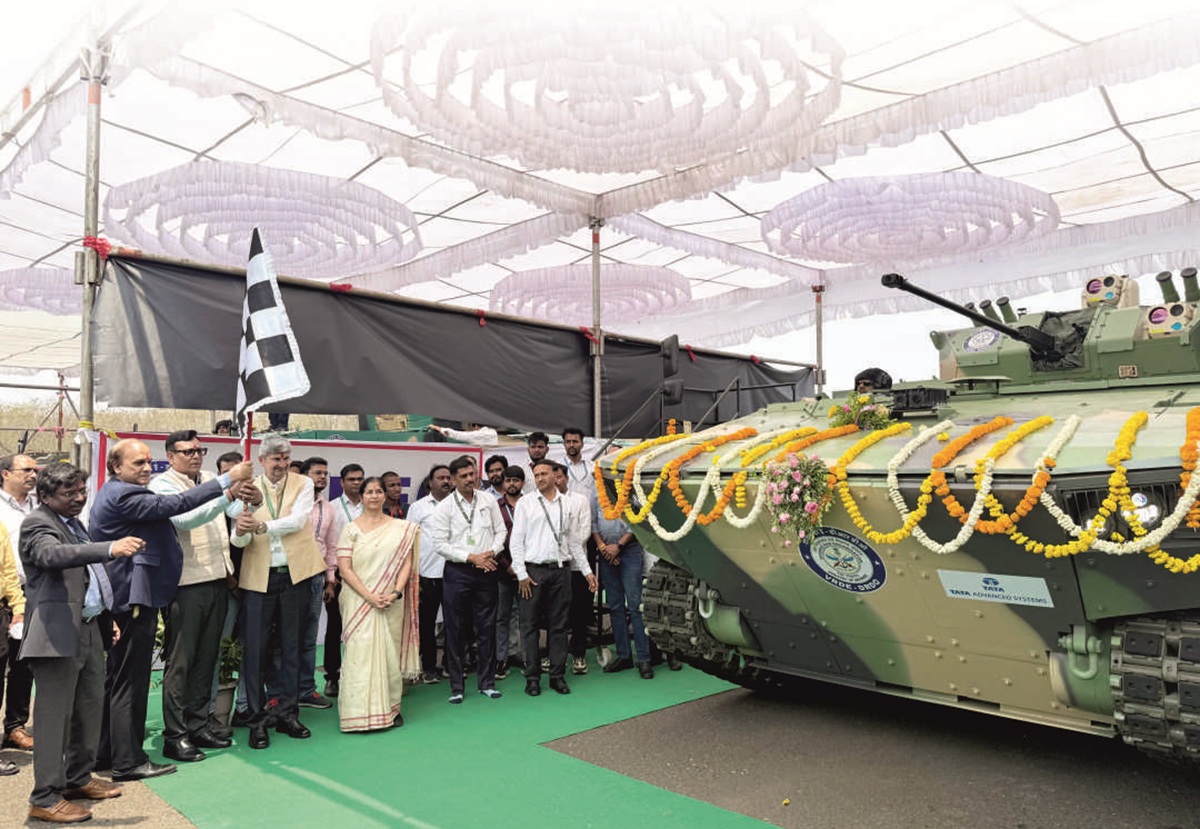
India has marked a significant milestone in its drive to enhance indigenous armoured vehicle capabilities with the rollout of the Vikram VT21 Advanced Armoured Platform (AAP) family. The ceremony, held at the Vehicles Research and Development Establishment (VRDE) in Ahilyanagar, signals progress in the development of next-generation tracked and wheeled combat vehicles intended for service with the Indian Armed Forces. The Vikram VT21 programme is being executed by the Defence Research and Development Organisation (DRDO) in partnership with Bharat Forge Limited (BFL) and Tata Advanced Systems Limited (TASL) under the Development-cum-Production Partner (DcPP) model. The AAP family comprises both tracked and 8×8 wheeled variants, designed to meet requirements for a modular, future-ready armoured fighting vehicle platform with a gross vehicle weight of approximately 24 tonnes.
The programme originated from a DRDO-issued Request for Proposal (RfP) in January 2023, which sought industry collaboration to develop a new generation of amphibious armoured platforms. Both variants are designed with a high degree of commonality and feature a compact integrated powerpack, automatic transmission, and modular protection systems. The vehicles are also configured with provisions for advanced subsystems, including laser warning receivers, countermeasure suites, loitering munitions integration, and mini unmanned aerial vehicle (UAV) interfaces. Development activity accelerated in April 2025, when metal-cutting ceremonies for both variants were conducted at partner production facilities in Pune. Initial timelines projected prototype rollouts by October 2025, followed by user trials for the tracked variant beginning in 2026 and potential induction into service from 2028. The programme is aligned with India’s Futuristic Infantry Combat Vehicle (FICV) requirement, with additional amphibious configurations under consideration.

On 25 April 2026, DRDO formally unveiled prototypes of both tracked and wheeled variants at VRDE. The platforms are intended to fulfill multiple operational roles, including infantry combat vehicle (ICV) and armoured personnel carrier (APC) missions. Leveraging an open-architecture design, the vehicles can be adapted for mission-specific configurations. Current indigenous content is estimated at approximately 65%, with plans to increase this to 90% as the programme matures. The AAP incorporates a V-shaped hull designed to mitigate the effects of mine blasts and improvised explosive devices (IEDs), alongside modular ceramic-composite armour packages. Protection levels are reported to meet STANAG 4569 Level IV (blast) and Level V (ballistic) standards. The platform also features a ground clearance of 500 mm to enhance survivability in high-threat environments.
In terms of armament, the Vikram VT21 is equipped with an unmanned turret mounting a 30 mm autocannon, complemented by a co-axial 7.62 mm machine gun and provision for anti-tank guided missiles (ATGMs). Targeting systems include advanced thermal and optical sights to support day/night operations. Propulsion is provided by a 720 hp diesel engine coupled with an automatic transmission, delivering mobility across diverse terrains while retaining amphibious capability. The combination of firepower, protection, and modularity positions the Vikram VT21 as a key element in India’s effort to modernise its mechanised forces with domestically developed systems.


