


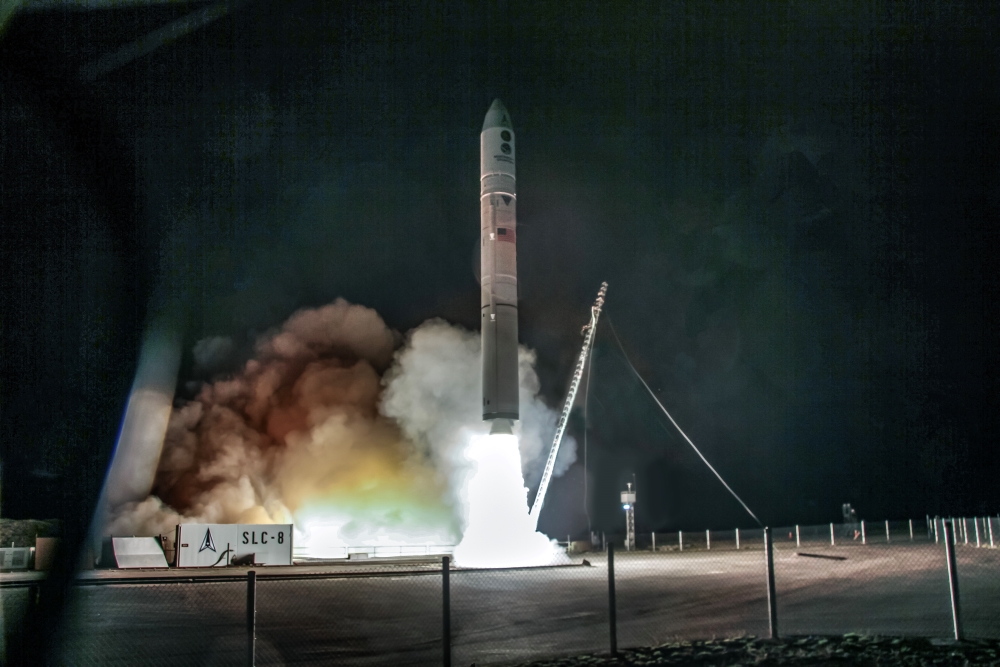
Northrop Grumman Corporation (NYSE: NOC) launched the STP-S29A mission aboard a Minotaur IV launch vehicle from Space Launch Complex 8 at Vandenberg Space Force Base, California, marking the 31st successful Minotaur launch since its inaugural flight in 2000. Minotaur IV is part of Northrop Grumman’s Minotaur family of vehicles for U.S. government space launch. Combining U.S. government-supplied Peacekeeper motors with the company’s proven commercial launch capabilities enables affordable, reliable and flexible access to space for the United States Space Force’s Rocket Systems Launch Program (RSLP) and other government partners. Recent design enhancements and technology upgrades to the Minotaur IV will streamline future missions by reducing the number of parts and processes, while simultaneously improving performance and enabling more responsive launches.
“The success of the STP-29A mission and continued evolution of our Minotaur IV design for future missions underscores Northrop Grumman’s commitment to delivering resilient and cost-effective space launch capabilities for our nation,” said Wes Collier, vice president, launch systems, Northrop Grumman.
STP-S29A is a mission under the U.S. Department of Defense’s Space Test Program (STP) that will deliver technology demonstrations to orbit and contribute to future space system development, with this launch delivering up to 200 kg of STP cubesats to Low Earth Orbit. The main payload will be STPSat-7, an ESPA class satellite based on the Aegis Aerospace M-1 satellite bus used on the STPSat-4 mission for hosting research and technology demonstration payloads for the Department of Defense (DoD). One of the payload is U.S. Naval Research Laboratory’s (NRL) Lightsheet Anomaly Resolution and Debris Observation (LARADO) instrument, used to detect and characterize lethal non-trackable orbital debris with lasers in orbit.


