


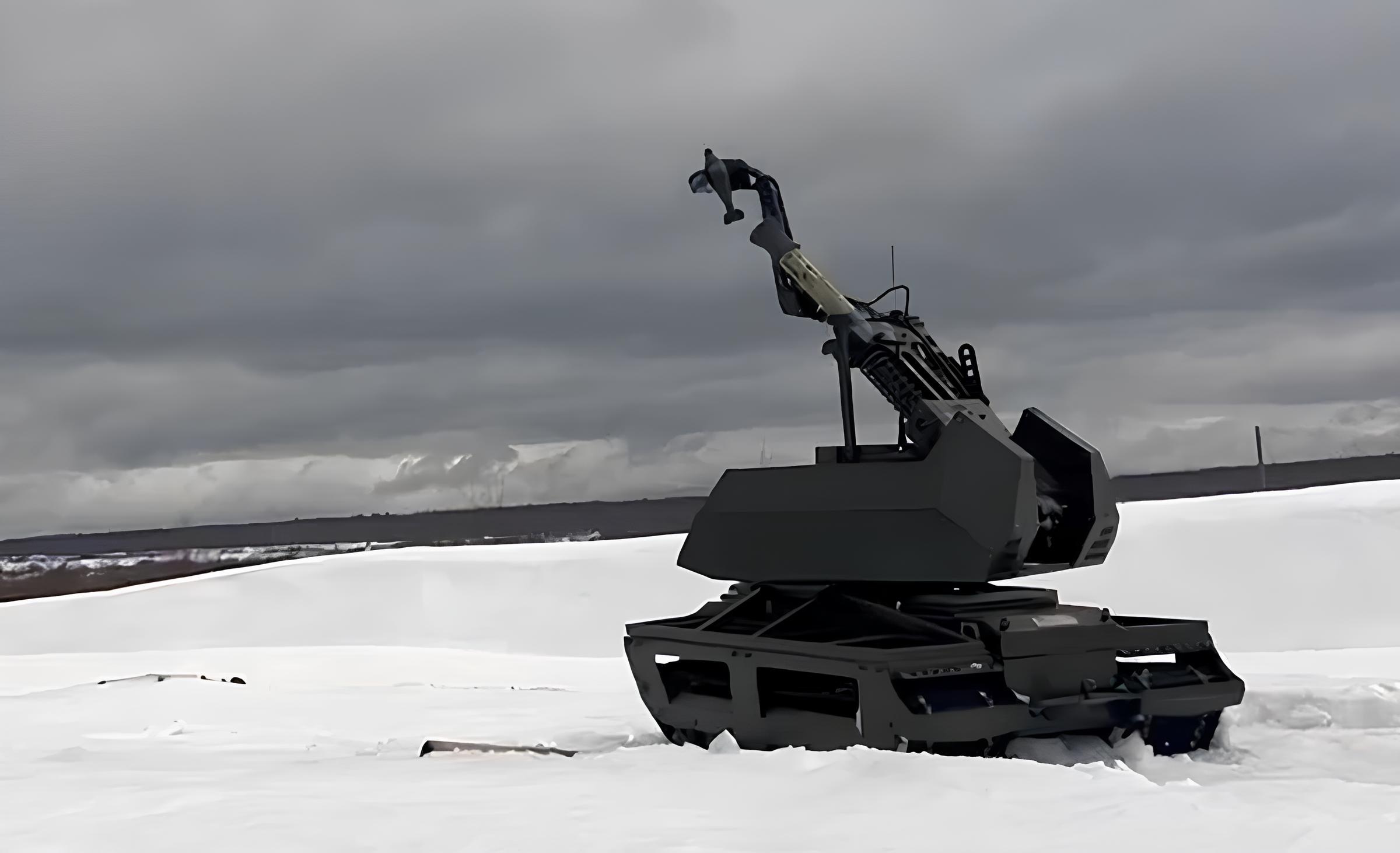
Russia has released video footage showing range trials of an unmanned ground combat system identified as “Kuryer,” equipped with a previously undisclosed automated mortar module designated “Bagunlnik-82.” The material, published via the NRTK channel focused on Russian ground robotics development, provides one of the clearest indications to date of Moscow’s ongoing efforts to field unmanned indirect fire capabilities. The footage depicts a tracked unmanned ground vehicle (UGV) fitted with a rotating turret integrating both an 82 mm mortar tube and an automated loading system. Following each firing cycle, a mechanical arm is shown retrieving and chambering a subsequent round in approximately five seconds. If reproducible under operational conditions, this rate would enable a sustained fire capability while minimizing exposure of personnel to counter-battery threats.
The Kuryer platform forms part of Russia’s broader development of unmanned ground combat complexes, known in Russian military terminology as NRTK. Unlike earlier configurations that relied on fixed forward-firing mounts, the integration of a stabilized, traversable turret allows the system to engage targets across a wider azimuth without requiring repositioning of the chassis. This enhances flexibility in both defensive and offensive fire missions, particularly in constrained or contested terrain. In addition to its mortar configuration, Kuryer is described as a multifunctional UGV with roles extending beyond fire support. The platform is reportedly capable of mine-laying operations, carrying up to 10 TM-62 anti-tank mines, as well as transporting ammunition and evacuating casualties. It can accommodate one wounded individual internally, with additional personnel able to ride externally if required.

The Bagunlnik-82 mortar module has not been previously reported in open sources. Based on its caliber and apparent configuration, it may be derived from the 2B24 82 mm mortar currently in Russian service, which is suitable for vehicle integration due to its relatively low weight. However, it remains unclear whether the system represents a modified legacy design or a purpose-built weapon optimized for unmanned deployment on a light tracked chassis. A notable feature distinguishing this system from earlier Russian unmanned ground platforms is the integration of an automated loading mechanism within a compact turret assembly. Previous UGV demonstrations have predominantly featured machine guns or anti-tank guided missiles, which do not require manual reloading in the same manner. Incorporating an autoloader for mortar rounds presents a more complex engineering challenge, and the footage suggests the concept has advanced to at least a functional prototype stage capable of live-fire testing.
The system may also be configured with alternative combat modules, including the AGS-17 automatic grenade launcher and NSVT or PKT machine guns, alongside auxiliary features such as a manipulator arm, a mine roller, and an onboard generator. The operational relevance of an unmanned mortar system lies in its potential to remove personnel from one of the most vulnerable roles on the battlefield. Conventional mortar teams are typically exposed during deployment, firing, and displacement, and are particularly susceptible to counter-battery fire once their position is detected. A robotic system capable of delivering indirect fire, relocating, and re-engaging without a crew at the firing point could significantly reduce these risks, while enabling commanders to position fire support assets in areas otherwise considered too hazardous for manned units.


