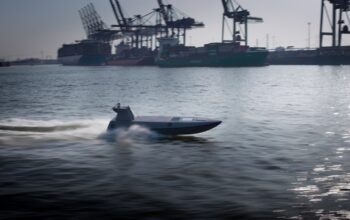
DARPA’s first-of-its-kind unmanned surface vessel, the USX-1 Defiant, has commenced extended sea trials to evaluate long-endurance performance and reliability. Following pre-departure testing near Port Angeles, the 180-foot, 240-metric-ton demonstrator transited the Strait of Juan de Fuca before reaching the Pacific Ocean earlier this week. The vessel, built under DARPA’s No Manning Required Ship (NOMARS) program, represents a major step in naval experimentation. Unlike conventional unmanned vessels derived from manned platforms, Defiant was designed from the keel up with no capacity for human presence. This radical design shift removes the need for crew-related infrastructure, enabling streamlined construction, reduced costs, and optimized hydrodynamic efficiency.
The NOMARS initiative challenges the legacy model of naval shipbuilding. By eliminating all human habitability requirements—such as berthing, life-support, and safety systems—the program has produced a simplified seaframe optimized purely for endurance and operational resilience. According to DARPA, the absence of human considerations is expected to enhance survivability against both harsh sea states and adversary actions, while also complicating tampering attempts. The vessel’s minimalist hull design further enables low-cost, scalable production, with maintenance possible at smaller Tier III shipyards more commonly servicing tugs, workboats, and yachts. This approach stands in contrast to the resource-intensive requirements of traditional naval shipyards.
The Defiant will undergo an extended period of at-sea trials to validate system integration, reliability, and autonomous control under operationally relevant conditions. DARPA officials describe the effort as a test of both mechanical endurance and the long-term functionality of advanced autonomy frameworks. While DARPA has not disclosed exact timelines or operational benchmarks, officials emphasize that the data collected will inform not only NOMARS development but also broader U.S. Navy unmanned surface vessel initiatives. Should NOMARS achieve its objectives, the program could enable the cost-effective scaling of distributed unmanned surface vessel (USV) fleets, supporting emerging U.S. Navy concepts for manned-unmanned hybrid operations. This shift would allow surface forces to expand coverage, absorb risk in contested environments, and maintain persistent maritime presence without committing crewed ships.
DARPA officials stress that NOMARS remains an experimental program. However, the christening of Defiant on 11 August at Everett Ship Repair in Washington marks a symbolic milestone in the evolution of naval technology. If successful, the vessel could become a template for future generations of unmanned warships designed around autonomy from inception. As the Defiant sails into the Pacific for its endurance trials, the program will be closely monitored across the defense sector as a potential harbinger of a hybrid, manned-unmanned maritime fleet. The Defense Advanced Research Projects Agency (DARPA) is a research and development agency of the United States Department of Defense responsible for the development of emerging technologies for use by the military. Originally known as the Advanced Research Projects Agency (ARPA), the agency was created on February 7, 1958, by President Dwight D. Eisenhower in response to the Soviet launching of Sputnik 1 in 1957.