


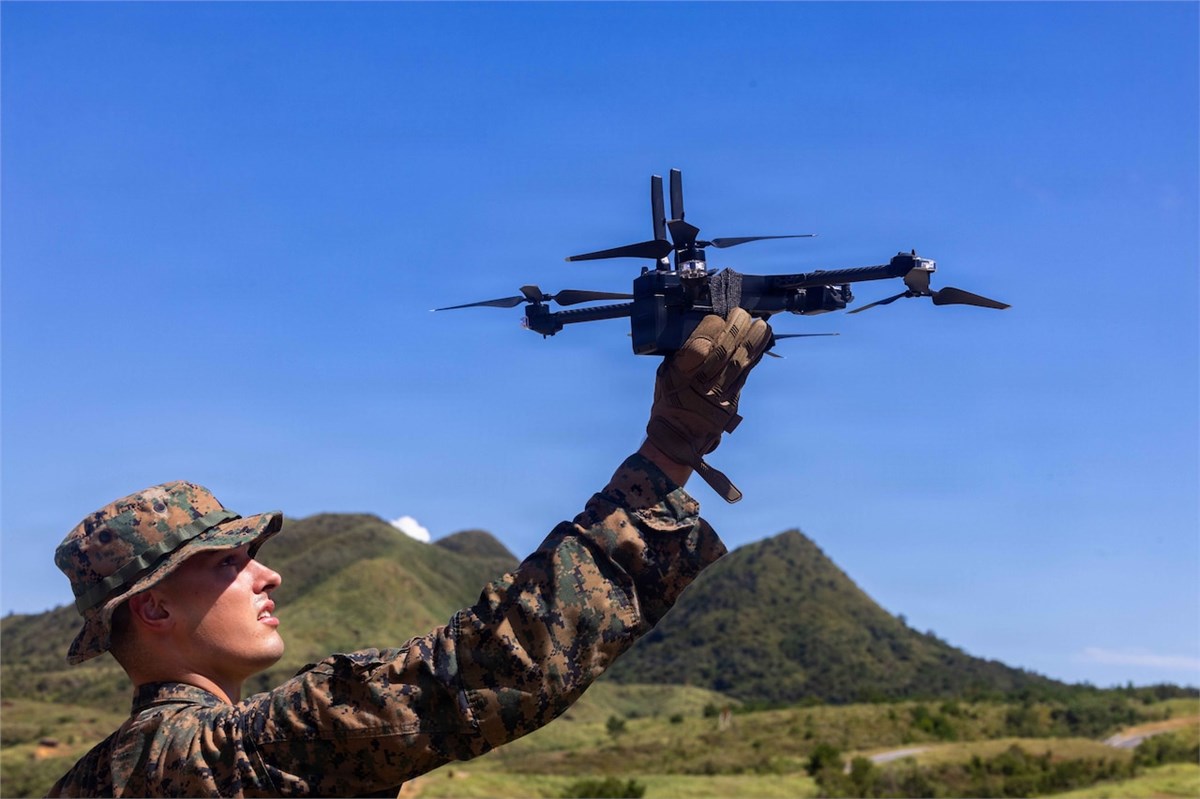
Marines assigned to the 4th Marine Regiment, 3rd Marine Division, successfully concluded the Marine Corps’ first series of live-fire first-person view attack drone flights yesterday in South Korea. This historic training series marks a significant milestone in force modernization, demonstrating the Marine Corps’ ability to field emerging technologies in the Western Pacific rapidly. The series featured two distinct training events: an inaugural range conducted July 30 by the 3rd Light Armored Reconnaissance Battalion, and a second iteration carried out yesterday by the 3rd Battalion, 7th Marine Regiment. Both are forward-deployed units to the Pacific region under the unit deployment program. Throughout the training series, Marines used the Neros Archer drone to execute precise anti-armor and antipersonnel explosive strikes. With an effective range of approximately 20 kilometers, this technology extends the tactical influence of small units far beyond traditional squad-level infantry weapons, allowing Marines to conduct precision strikes from positions of relative safety.
“Training with these FPV drone systems with deployed Marines, on a live-fire range and in a unique environment allows us to get one step further toward integrating it into real-world operations. We learn what works, and most importantly, what needs to be worked on and refined, so that when the time comes to use the Neros Archer on the battlefield, we have perfected the craft,” said Marine Corps 1st Lt. Evan Brace, 3rd Light Armored Reconnaissance Battalion company executive officer. Equipping our Marines with FPV attack drones give us a useful tool that provides an additional kinetic option for us to use. This capability allows units down to the fireteam level to possess organic, precise fires capable of shaping their battlespace. Many of the obstacles we encountered before conducting this training, since it was the first of its kind here in [South] Korea, were overcome through a mission-focused mindset and through close cooperation and coordination with our [South] Korean allies.”

“The Neros Archer live-fire training proves that when we hand cutting-edge attack drones to our young Marines, they rapidly adapt, turning small units into highly lethal, self-sufficient precision strike force. By mastering this technology, we are not just upgrading our tactics, we are building a faster, smarter and deadlier team capable of standing shoulder to shoulder with our South Korean allies, ready to dominate any modern battlefield. This training is significant because it is the first series of FPV attack drone flights conducted by U.S. Marines in South Korea. I’m proud that my team of professionals and I are able to play a small part in moving the needle forward when it comes to employing this emerging technologys,” said Marine Corps Sgt. Maj. Ismael Bamba, U.S. Marine Corps Forces Korea senior enlisted leader.
This training increases the 4th Marine Regiment’s tactical proficiency with drones in offensive and defensive scenarios, extending traditional marksmanship into the unmanned domain. Small drone platforms like the Neros Archer give Marines at the squad and platoon level a modern, cost-effective alternative to many larger firing platforms that are not organic to smaller units. Conducting this live-fire series on the Korean Peninsula required a comprehensive safety and airspace structure. The 4th Marine Regiment worked in close coordination with the 2nd Infantry Division, 8th Army, and the 2nd Combat Aviation Brigade to establish the necessary regulatory frameworks in conjunction with South Korea. Before each live-fire execution, Marines conducted rigorous dry-fire safety rehearsals and built-in procedural checks to validate protocols for high-explosive drone training iterations. By rapidly adapting to the demands of the future operating environment and validating these systems alongside the joint force and regional allies, the 4th Marine Regiment continues to ensure that the 3rd Marine Division remains a highly capable, ready and survivable forward-deployed force, uniquely postured to safeguard regional stability. This training aims to enable and expand opportunities for future joint and allied FPV attack drone training.


