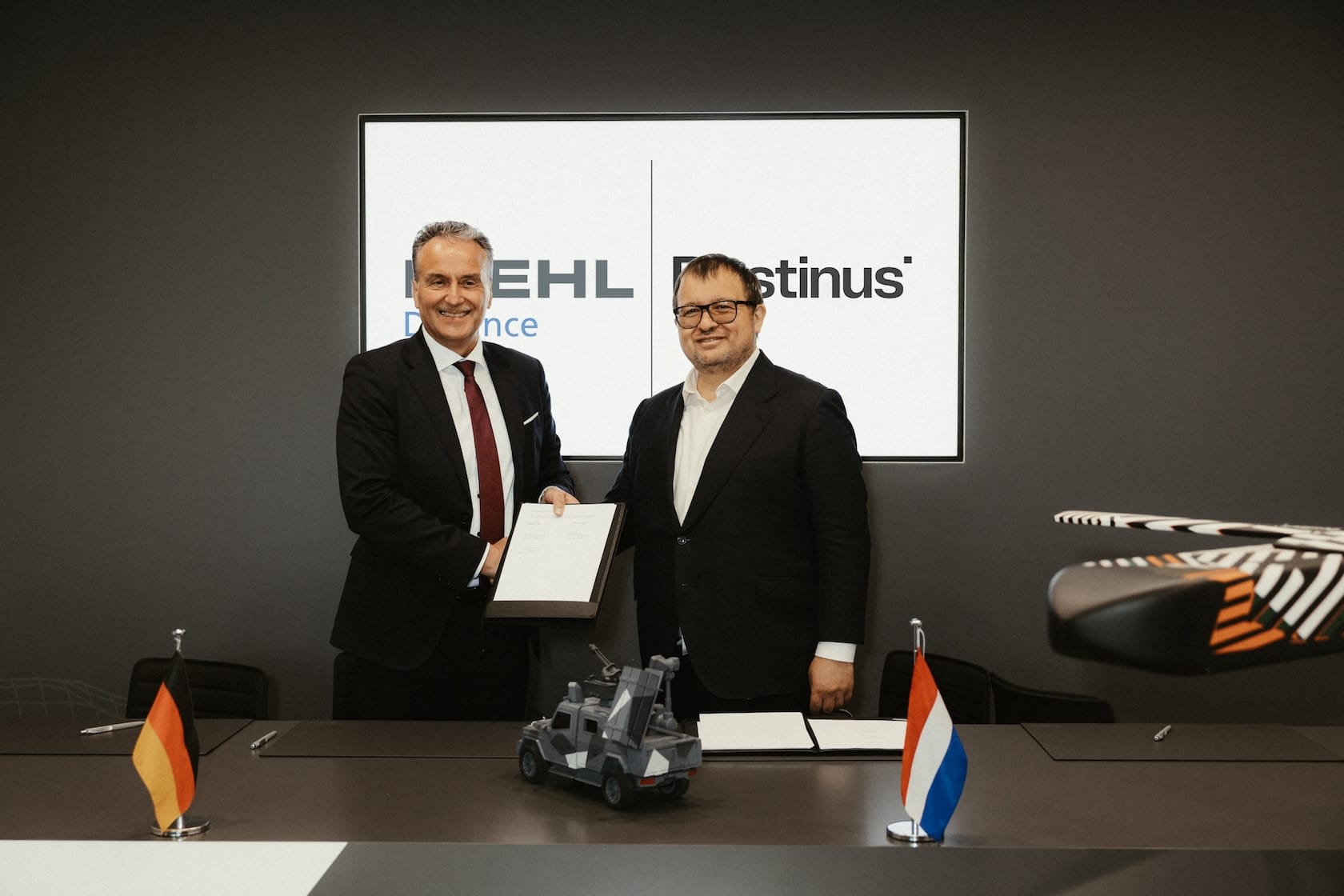
Destinus and Diehl Defence have signed a teaming agreement at ILA Berlin Airshow 2026 to cooperate on European ground-based air defence and counter-UAS systems. As a first step, the Destinus Hornet interceptor will be integrated into Diehl Defence’s GARMR counter-UAS system as an additional effector, adding a new interceptor class to a layered air defence architecture. The agreement also establishes a pathway for Hornet to serve as a future secondary effector option within IRIS-T ground-based air defence (GBAD) systems, subject to phased validation and applicable approvals.
GARMR is designed as a hybrid, modular system with a wide range of applications. It is suitable for the protection of critical civilian infrastructure (e.g. buildings or events) as well as for operation in high-intensity military combat scenarios. This flexibility results from the parallel use of two interceptor drone technologies: GARMR SRS (Short Range System) uses the CICADA interceptor drone with a catch net or warhead, while GARMR MRS (Medium Range System) additionally neutralizes targets with innovative interceptor drones. However, further effectors can be integrated for both ranges so that the system can be optimally adapted to the situation: from precise, controlled impact in sensitive civilian environments to performanceoptimized defence against complex military threats, even over longer distances.

“Modern air defence is no longer just a matter of capability. It is a question of capacity and cost-per-engagement,” said Mikhail Kokorich, CEO of Destinus. “Hornet adds a cost-effective layer beneath established systems, improving magazine depth and strengthening the overall architecture under high-volume threat conditions.”
Hornet is built for the gap that defines today’s threat picture: head-on interception of fast, low-cost aerial threats, including jet-powered one-way attack drones and glide bombs, a target class that sits between classic counter-UAS effectors and high-end air defence missiles. Engaging these threats with high-value interceptors may win an engagement, but it does not scale under saturation. Hornet adds a second effector layer that extends magazine depth and preserves high-value interceptors for the targets that demand them. The integration builds on GARMR’s modular, standard-interface architecture, enabling multiple effectors and engagement concepts within a single command-and-control framework. The work will follow a phased validation approach aligned with institutional requirements and applicable approvals.