


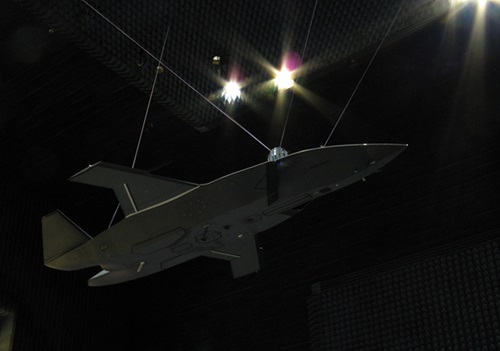
Boeing [NYSE:BA] has validated another advanced capability for the MQ-28 collaborative combat aircraft, which gives customers a decisive edge in combat: stealth performance. The MQ-28 Ghost Bat is designed to complement existing crewed aircraft by performing a variety of roles, including surveillance, electronic warfare, and force multiplication, all while maintaining a low radar profile. This milestone further demonstrates the platform’s maturity, survivability, and ability to deliver cost-effective advanced capability for modern air combat operations. One way to measure the stealth of an aircraft is Radar Cross Section (RCS) testing. RCS testing was conducted on an MQ-28 to provide customers with objective, repeatable data about survivability and detection risks. This information validates designs and models, supports procurement and certification, and guides tactics and countermeasure choices. The MQ-28’s RCS reduces the range that enemy radars can detect and engage an MQ-28, enhancing the platform’s survivability in contested environments. The success of the RCS testing confirms the effectiveness of the MQ-28’s design, production and material choices in minimising radar detection.
“The combination of a highly capable platform, stealth features, advanced autonomy and artificial intelligence provides unprecedented ability for air forces to extend their mission effectiveness and operational flexibility,” said Brad Thompson, Director for Phantom Works Australia.
MQ-28 began development in 2017, took its first flight in 2021, and has completed more than 150 flights and several flight demonstrations including:
- Demonstrating interoperability by teaming two in-flight MQ-28s plus one digital aircraft with an airborne E-7A Wedgetail to complete a mission against an airborne target
- Deploying to an unfamiliar location – an operational RAAF Base at Tindal
- Progressing airborne teaming with multiple MQ-28 aircraft
- Conducting daily flight operations during test blocks
- Teaming with an E-7A and an F/A-18F to autonomously fire, and shoot down, an airborne target.
- Logging its first three international operational flight tests in Point Mugu, California to validate autonomous operations, demonstrate rapid deployment and sustained operations from an allied location.
The Boeing MQ-28 Ghost Bat, previously known as the Boeing Airpower Teaming System (ATS), is a stealth, multirole, unmanned combat aerial vehicle under development by Boeing Australia for the Royal Australian Air Force (RAAF). It is designed as a force multiplier aircraft capable of flying alongside crewed aircraft for support as part of an integrated system (loyal wingman) including space-based capabilities, and performing autonomous missions independently using artificial intelligence. As of 2025, the aircraft are designed and built in Melbourne at Boeing Aerostructures Australia with future production planned in Wellcamp, Toowoomba. The wing is Boeing’s largest resin-infused single composite component, featuring electromechanical actuators and controllers for the primary flight control system, and has a modular, swappable mission nose package system. The United States Air Force, United States Navy, Royal Air Force, Royal Navy and German Army (Bundeswehr) are possible operators. Japan has also shown interest in the Ghost Bat, establishing a framework on Collaborative Combat Aircraft activities in April 2026.


