


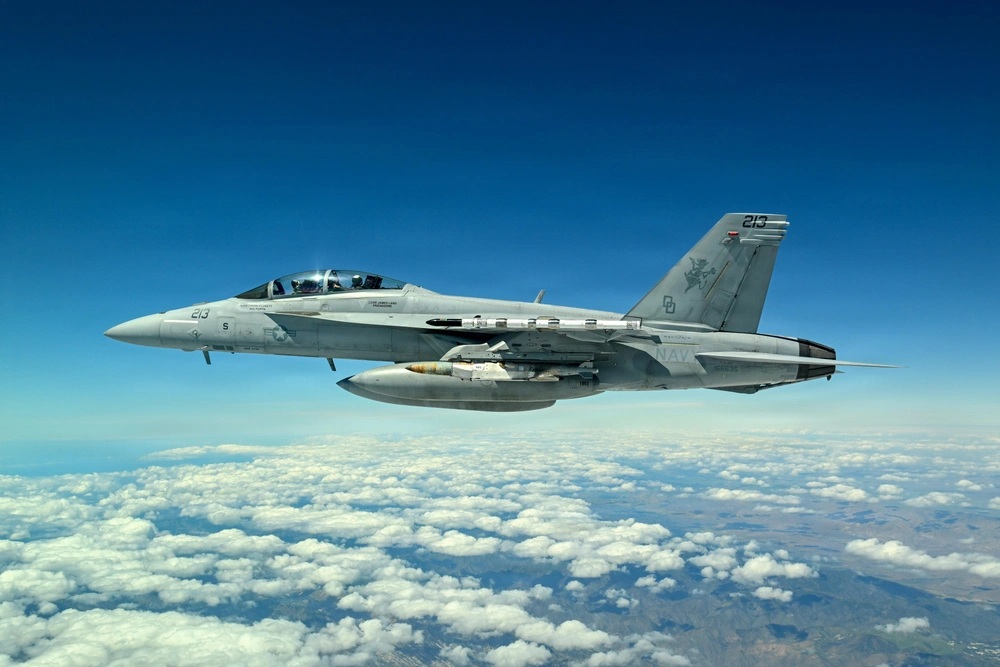
The U.S. Navy recently demonstrated the new Joint Direct Attack Munition (JDAM) Long Range (LR) variant in early April, marking a significant milestone in bringing a new option for affordable, producible, standoff strike capability to the Carrier Air Wing. The two test events demonstrated the weapon’s safe separation; the ability to use existing aircraft interfaces; and controlled, powered free-flight and navigation. Each demonstration traveled approximately 200 nautical miles, while maintaining consistent guidance directly to its target. With the successful completion of these demonstrations, the JDAM LR team is now focusing on the next phase of qualification, with emphasis on shipboard integration. The program remains committed to bringing this high-priority strike capability to the fleet to meet the evolving demands of modern naval warfare.
“As Naval Air Forces in theater continue to rely heavily on JDAM systems, the program recognizes a critical need to provide the fleet with greater standoff range,” said Capt. Sarah Abbott, Precision Strike Weapons (PMA-201) program manager. “This new capability allows pilots to engage targets from significantly safer distances, maintaining a tactical advantage in contested environments.”

The Joint Direct Attack Munition (JDAM) is a guidance kit that converts unguided bombs, or “dumb bombs”, into all-weather precision-guided munitions (PGMs). JDAM-equipped bombs are guided by an integrated inertial guidance system coupled to a Global Positioning System (GPS) receiver, giving them a published range of up to 15 nautical miles (28 km). JDAM-equipped bombs range from 500 to 2,000 pounds (230 to 910 kg). The JDAM’s guidance system was jointly developed by the United States Air Force and United States Navy, hence the “joint” in JDAM. When installed on a bomb, the JDAM kit is given a GBU (Guided Bomb Unit) identifier, superseding the Mark 80 or BLU (Bomb, Live Unit) nomenclature of the bomb to which it is attached.
The JDAM is not a stand-alone weapon; rather it is a “bolt-on” guidance package that converts unguided gravity bombs into PGMs. The key components of the system are a tail section with aerodynamic control surfaces, a (body) strake kit, and a combined inertial guidance system and GPS guidance control unit. The JDAM was meant to improve upon laser-guided bomb and imaging infrared technology, which can be hindered by bad ground and weather conditions. Laser seekers are now being fitted to some JDAMs. JDAM bombs are inexpensive compared to alternatives such as cruise missiles. The original cost estimate was $40,000 each for the tail kits; however, after competitive bidding, contracts were signed with McDonnell Douglas (later Boeing) for delivery at $18,000 each.


