


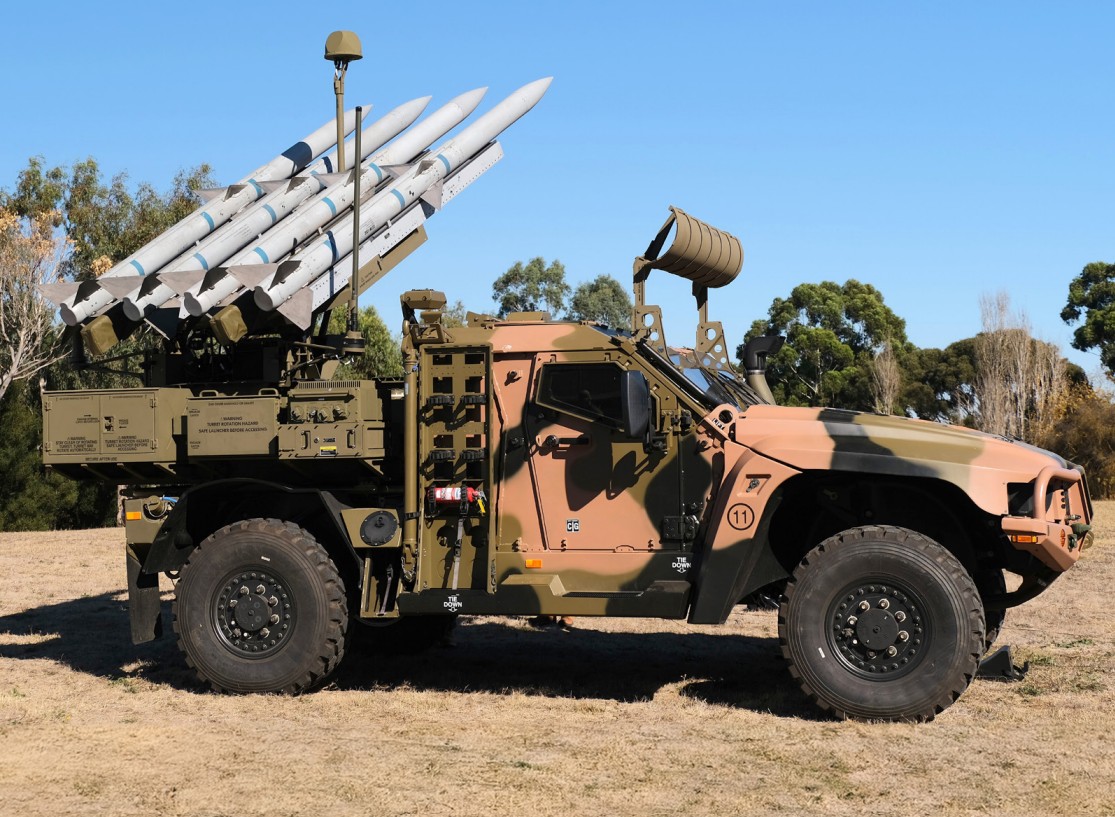
The Australian Army is advancing its short-range ground-based air defence (SRGBAD) capability under Land 19 Phase 7B through the fielding of two launcher configurations for the National Advanced Surface-to-Air Missile System (NASAMS). These comprise Kongsberg’s baseline Mk 2 six-cell canister launcher mounted on an HX77 8×8 truck, alongside a lighter, vehicle-integrated solution based on a Norwegian design. The latter forms part of an Australian-developed ‘Enhanced NASAMS’ construct, integrating indigenous sensors and mobility platforms. Central to this configuration is the High Mobility Launcher (HML), developed by Raytheon Australia, which has been fitted onto the rear tray of the two-door Hawkei Protected Mobility Vehicle – Light produced by Thales Australia in Bendigo. The Hawkei-mounted NASAMS variant provides a deployable and highly mobile GBAD capability, transportable via Lockheed Martin C-130J Hercules and Boeing C-17A Globemaster III, as well as by littoral landing craft. This enhances the Australian Army’s ability to support expeditionary and coastal operations.
Originally developed for the US Army’s now-cancelled Surface-Launched AMRAAM programme, the HML has since been incorporated into NASAMS architecture and is operational with Norwegian forces. In Australian service, the launcher mounted on Hawkei offers full 360-degree traverse and is powered by the host vehicle. Engagements are controlled remotely via a truck-mounted Fire Distribution Centre (FDC), although an onboard control interface provides emergency firing capability for the two-person crew. The launcher supports a mixed loadout of six missiles, including radar-guided AIM-120 AMRAAM and imaging infra-red guided AIM-9X Block II. The system is also compatible with the extended-range AMRAAM-ER, offering increased engagement envelopes in both altitude and distance, although this variant has yet to enter Australian service.

Raytheon Australia indicated that the HML integration onto Hawkei was completed domestically over a 24-month period, incorporating local industry participation. The effort marks the first instance of the Hawkei being employed as a dedicated weapons carrier, demonstrating the flexibility of its 2.25-tonne payload capacity. A Hawkei-based NASAMS fire unit also includes dedicated sensor variants. These comprise an electro-optical/infra-red configuration equipped with the AN/AAS-52 Multi-spectral Targeting System (MTS)-A and a radar variant incorporating an active electronically scanned array (AESA) fire control radar developed by CEA Technologies. The EO/IR system, mounted on a 5 m telescopic mast, provides passive long-range detection, identification, and tracking, and is already in service with the Australian Defence Force aboard Sikorsky MH-60R Seahawk helicopters.
Operationally, the National Advanced Surface-to-Air Missile System (NASAMS) will be fielded by the 16th Regiment, Royal Australian Artillery, under the 10th Brigade, currently based in Woodside, South Australia. Infrastructure upgrades under Land 19 Phase 7B include new facilities at the Edinburgh Defence Precinct, with unit relocation expected in late 2025. Raytheon Australia has not disclosed procurement quantities for the Hawkei-NASAMS configuration nor timelines for achieving initial or final operational capability. The Australian Army previously conducted its first live-fire trial of the NASAMS Mk 2 canister launcher at the Woomera Test Range in November 2023, marking a key milestone in the programme’s progression.

(Photo by Raytheon)


