


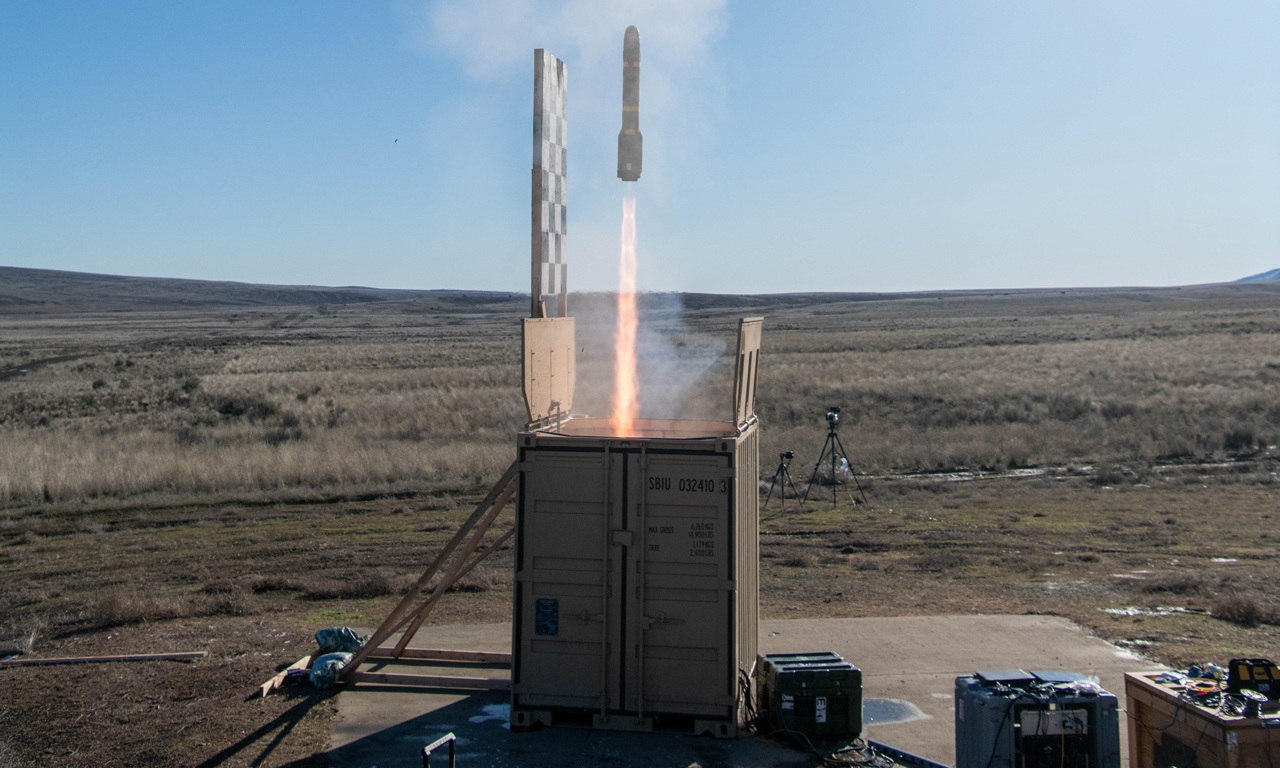
Lockheed Martin has conducted a series of live-fire trials of its GRIZZLY containerised launcher, including the first integrated firing and vertical launch of an AGM-114 HELLFIRE missile from the system. The tests mark a key milestone in validating the concept of a rapidly deployable, container-based precision strike capability. According to the company, the trials demonstrated the launcher’s ability to load and fire missiles from a standard 10 ft Tricon container. The GRIZZLY system has been developed over a six-month period using existing, fielded technologies, including elements derived from the M299 launcher architecture. This approach is intended to accelerate development timelines while reducing technical risk.
During the test campaign, the system successfully met all primary performance objectives, including confirming missile launch parameters and real-time trajectory performance. The trials are understood to have validated both the mechanical integration of the launcher and its ability to execute vertical launch profiles using HELLFIRE-class munitions. Lockheed Martin stated that the GRIZZLY concept is designed to provide a distributed, low-signature fires capability suitable for expeditionary operations. By leveraging a containerised format, the system can be deployed using standard logistics infrastructure, enabling rapid relocation and concealment in contested environments.
The company emphasised that GRIZZLY utilises commercial off-the-shelf components to reduce procurement and sustainment costs. This design philosophy also minimises the logistical footprint, while enabling faster acquisition cycles compared with traditional launcher systems. In addition, the launcher is designed to be platform-agnostic, with compatibility across a range of command-and-control networks and sensor inputs. This allows integration into joint and multi-domain operations without requiring dedicated infrastructure. The GRIZZLY programme reflects a broader trend towards modular, rapidly deployable weapon systems aimed at enhancing flexibility and survivability. Such systems are increasingly seen as critical in distributed operations, where mobility, concealment, and responsiveness are key operational drivers.
Lockheed Martin noted that data collected during the trials will inform further development, with ongoing collaboration expected between the company and the US government. Future iterations of the system are likely to incorporate incremental improvements based on test results and operational requirements. The Lockheed Martin Corporation is an American defense and aerospace manufacturer. It is headquartered in North Bethesda, Maryland, United States. The company was formed by the merger of Lockheed Corporation with Martin Marietta on March 15, 1995. Lockheed Martin operates 4 divisions: Lockheed Martin Aeronautics; Lockheed Martin Missiles and Fire Control; Lockheed Martin Rotary and Mission Systems; and Lockheed Martin Space.


