


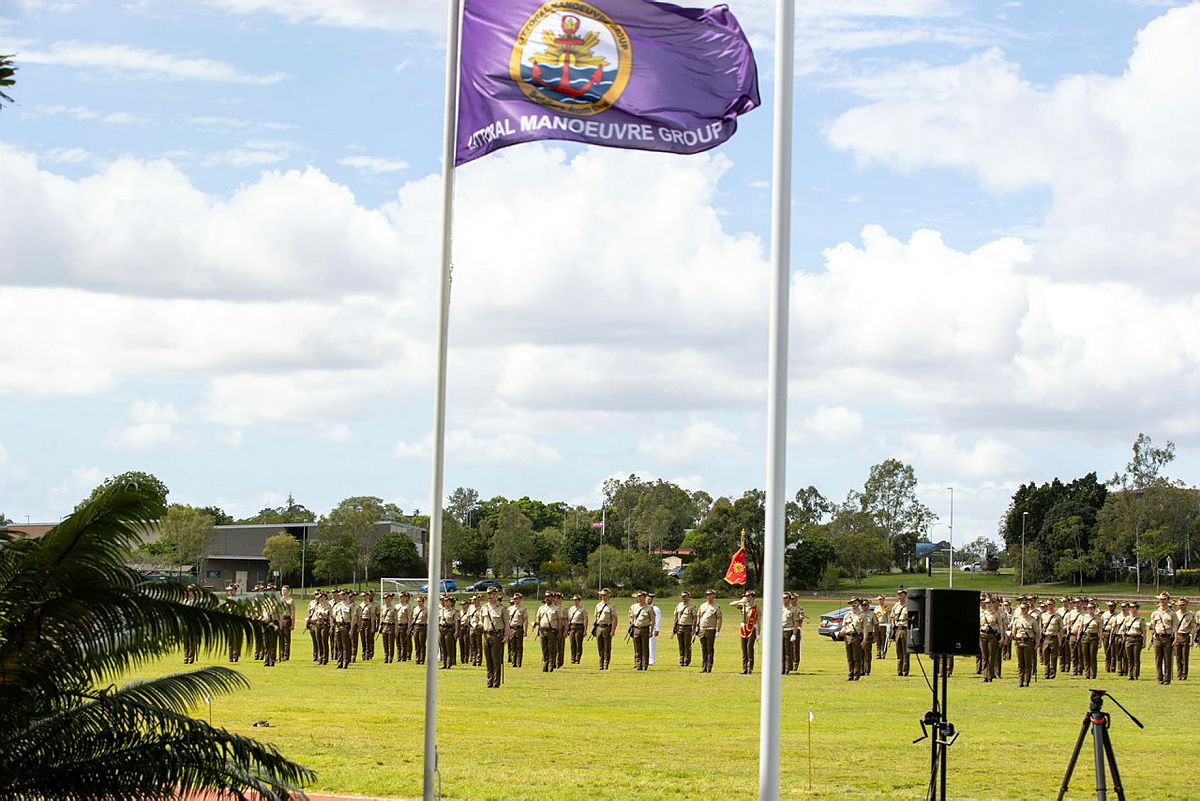
The Australian Army has formally marked the establishment of its new Littoral Manoeuvre Group (LMG) with a ceremonial parade held at Gallipoli Barracks in Brisbane, underscoring a key step in the service’s force modernisation efforts aligned with Australia’s evolving strategic posture. The LMG is intended to enhance the Army’s capacity to manoeuvre, deploy, and sustain land forces across littoral environments, including coastal and archipelagic regions. The capability is designed to support the objectives outlined in Australia’s National Defence Strategy, particularly in relation to operations across the Indo-Pacific.
Headquartered in Brisbane, the LMG will comprise a core element built around its headquarters and the 1st Landing Craft Battalion. These units are expected to provide scalable amphibious and littoral support to joint operations throughout the Indo-Pacific region. As part of the restructuring, existing Army units—including the 35th Water Transport Squadron and the Littoral Riverine Survey Squadron—have been reassigned under the LMG. This consolidation is intended to integrate specialised capabilities and streamline command and control arrangements within the 17th Sustainment Brigade.

Further expansion of the capability is planned, with two additional landing craft battalions to be established in the Northern Territory and northern Queensland. These units will be co-located with Army combat brigades, enhancing operational reach and responsiveness across key strategic corridors. The Australian Department of Defence is also accelerating procurement efforts to support the LMG, including the acquisition of medium and heavy landing craft, upgraded amphibious vessels, and supporting infrastructure. These platforms will enable the rapid deployment and sustainment of heavy and mechanised forces, including main battle tanks, infantry fighting vehicles, and precision strike systems, across austere and contested environments.
The transition of units and development of a specialised workforce are progressing in parallel. He emphasised the importance of personnel development through targeted training programmes, new career pathways, and close cooperation with the Royal Australian Navy and vocational training institutions. These initiatives aim to generate a capable cadre of littoral warfare specialists to support the long-term operational effectiveness of the group. The formation of the LMG reflects the service’s transition towards a more agile and regionally focused force structure. He noted that the capability will improve the Army’s ability to project force, control key terrain, and deny adversary access across Australia’s northern approaches.


