


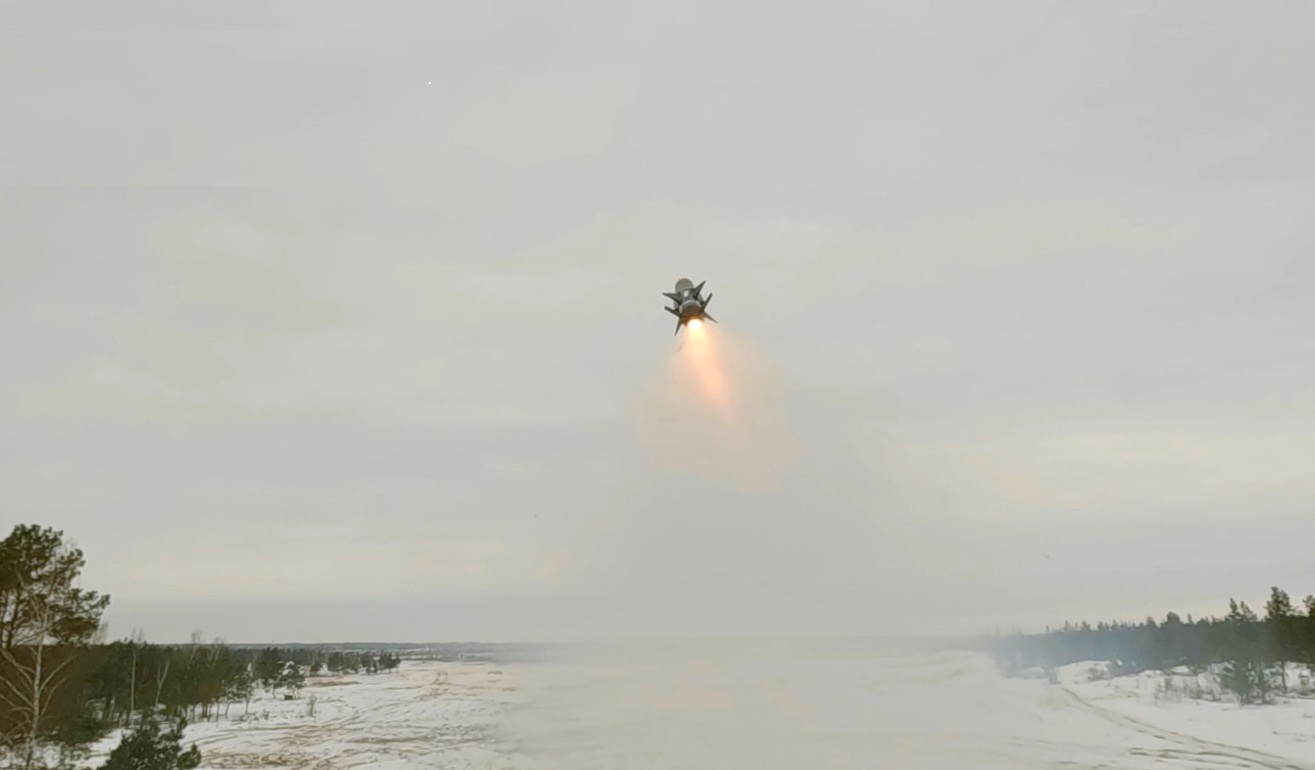
Estonia-based Frankenburg Technologies has unveiled its Mark I ultra short-range air defense (VSHORAD) missile, designed primarily to counter the growing threat posed by uncrewed aerial vehicles (UAVs). Headquartered in Tallinn, Frankenburg Technologies is focused on developing missile systems intended to neutralise modern aerial threats—particularly low-cost drones—while maintaining production costs comparable to, or potentially lower than, those of the threats they are designed to intercept. The Mark I represents the company’s first operational product within this portfolio. The Mark I is a compact interceptor with a launch weight of less than 2 kg. The missile measures approximately 660 mm in length and 60 mm in diameter. It is capable of engaging incoming UAVs at ranges of up to 2 km and altitudes of around 1,500 m. Propulsion is provided by a solid-fuel rocket motor, while the missile carries a 0.5 kg high-explosive fragmentation warhead equipped with a proximity fuze and a self-destruct function. The missile operates as a fire-and-forget system using an electro-optical seeker capable of day and low-light operation.
Frankenburg Technologies stated that the Mark I is primarily intended to counter long-range attack UAVs, with the Iranian-designed Shahed series cited as a benchmark threat. Additional intended targets include reconnaissance and low-flying drones such as the Orlan, Zala, and Supercam systems currently employed by Russian forces in Ukraine. The interceptor is also designed to engage loitering munitions and first-person-view (FPV) drones. While the company did not disclose the missile’s maximum speed, it stated that the Mark I is effective against slow-moving propeller-driven drones travelling at approximately 150–200 km/h, as well as jet-powered UAVs operating within the 400–650 km/h speed envelope. A future variant of the missile is expected to incorporate a radio-frequency (RF) seeker currently under development. This upgrade would provide all-weather, day-and-night engagement capability. The company noted that the Mark I’s modular architecture allows such upgrades to be integrated easily while also supporting on-site assembly and scalable production. Frankenburg Technologies maintains its headquarters in Estonia but also operates facilities or offices in Latvia, Lithuania, Ukraine, Denmark, Poland, and the United Kingdom.

The company currently employs approximately 70 personnel and intends to double its workforce by the end of the year. Development of the Mark I began approximately 15 months ago, in late 2024. According to the company, most development and trial activities have now been completed. Production is expected to begin in May, with initial deliveries scheduled for July. In parallel with the ground-based system, Frankenburg Technologies is developing an air-to-air version of the Mark I. The proposed configuration includes a twin-rail launcher with two missiles and a combined system weight of less than 8 kg. Such a lightweight configuration is intended to allow integration onto small unmanned aerial platforms, effectively turning them into drone-hunting assets. The system can be mounted either on mobile platforms or installed at fixed sites, a deployment concept the company believes could play a key role in protecting critical national infrastructure (CNI).
According to Frankenburg’s estimates, more than 2,000 CNI locations exist along NATO’s eastern flank alone, with approximately 550 missiles required to defend a single site against a large-scale drone attack. Frankenburg Technologies reported that 53 live-fire tests have been conducted to date, although only around half achieved the desired level of accuracy. The development effort reflects the rapid increase in UAV threats, with Russia reportedly producing more than 6,000 one-way attack UAVs in 2024. Launch rates during 2025 have in some cases reached between 500 and 700 drones in a single day. The company positions the Mark I as a cost-effective alternative to traditional short-range air defence missiles. While a conventional FIM-92 Stinger interceptor can cost close to USD500,000 per unit, Frankenburg Technologies expects its Mark I missile to be available at roughly one-tenth of that cost. With its compact dimensions, the Mark I is described by the company as the smallest guided interceptor missile currently in development.


