


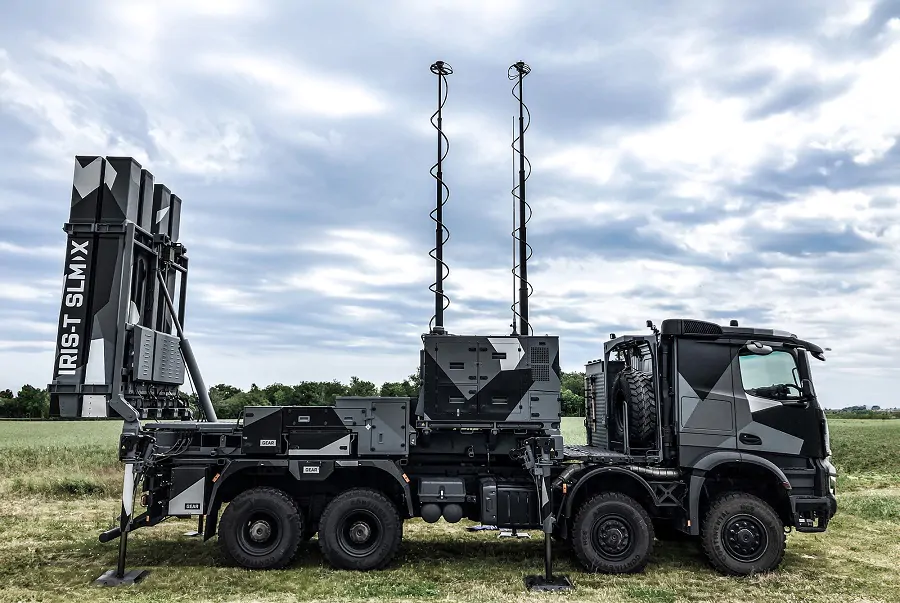
Germany and Switzerland have formalised a programme agreement for the joint procurement of IRIS-T SLM medium-range ground-based air defence (GBAD MR) systems under the framework of the European Sky Shield Initiative (ESSI). The bilateral agreement was signed by Swiss National Armaments Director Urs Loher and his German counterpart, Vice Admiral Carsten Stawitzki, marking a significant step in multinational defense cooperation within continental Europe. The programme agreement, approved by the Swiss Federal Council on 20 June 2025, lays the groundwork for Switzerland’s acquisition of five IRIS-T SLM fire units. These systems are intended to bolster the Swiss Armed Forces’ GBAD MR capability, as part of its broader air defense modernization strategy. Launched by Germany in 2022, the ESSI aims to address capability gaps in European integrated air and missile defense by coordinating procurement, improving cost-efficiency, and reinforcing interoperability among participating nations. Switzerland formally joined ESSI in October 2024.
Switzerland’s participation in this ESSI-facilitated procurement is consistent with its neutrality policy, as the agreement stipulates full operational autonomy over the deployed systems. The country is not obliged to integrate the procured IRIS-T SLM batteries into NATO or German command structures. However, the initiative allows for cost-sharing, streamlined logistics, and interoperability benefits, all central tenets of the ESSI vision. The Swiss Federal Office for Defence Procurement (armasuisse) is overseeing the acquisition process. Funding for the programme—totalling CHF 660 million (USD 830 million)—was allocated under Switzerland’s 2024 armament plan. Negotiations with the system’s prime contractor, Diehl Defence, are reportedly in the final stages, with a contract signature expected by summer 2025. Once concluded, the deal will position Switzerland among a growing cohort of European nations equipping their air defense forces with the IRIS-T SLM system, alongside Germany, Ukraine, and Egypt.
IRIS-T SLM (Surface Launched Missile) Air Defence SystemThe IRIS-T SLM (Surface-Launched Medium range) is part of the broader IRIS-T family developed by Diehl Defence. It is derived from the IRIS-T air-to-air missile, with significant modifications for ground-based engagements. Key enhancements include a larger 152 mm rocket motor (compared to the original 127 mm), GPS-aided inertial navigation, and a terminal infrared seeker optimized for high-mobility aerial targets. Each IRIS-T SLM battery typically includes a tactical operations center, radar assets, and 3–4 launchers. The system is capable of integration with multiple radar types, including Hensoldt’s TRML-4D, Saab’s Giraffe 4A, and the Thales Ground Master 200 MM/C. Fire control is often managed through modular command-and-control suites such as Airbus’s Fortion IBMS or Lockheed Martin’s SkyKeeper. The IRIS-T SLM is designed to intercept a range of aerial threats including aircraft, cruise missiles, UAVs, and precision-guided munitions, thereby filling a critical gap between short-range and long-range air defense assets. Its addition complements Switzerland’s existing capabilities and provides a mobile, rapidly deployable system for countering evolving aerial threats at medium altitudes and ranges.
From a strategic standpoint, the system enhances national autonomy in air defense while simultaneously supporting Europe-wide initiatives for layered, network-centric missile defense. The IRIS-T SLM system entered operational service with the German Luftwaffe in 2024 and is set to expand to a total of six batteries by 2027. The system is also operational in Ukraine and Egypt, with the latter integrating it with TRML-4D radars and MAN 8×8 trucks as part of a broader modernization of its air defense forces. Additional orders from international customers are anticipated, especially in the context of increasing missile and drone threats across Europe and the Middle East. Switzerland’s decision to join this procurement reflects not only its commitment to modernizing national defense, but also its willingness to cooperate on security frameworks with European partners—albeit within the bounds of its policy of armed neutrality.


